Skip to content

A water stain beside your fireplace doesn’t automatically mean your roof is leaking. On many Atlanta homes with prefabricated fireplaces, the real problem sits several feet higher: the metal chimney chase cover sitting on top of the chimney structure.
A chase cover is essentially the metal roof of a framed chimney chase. Its job is to keep rain out of the hollow structure surrounding the factory-built chimney system. When that metal rusts, sags, separates, or develops holes, rainwater can enter directly into the chase and travel down through the wood framing long before you ever see a drip inside your home.
That matters in Atlanta, where the National Weather Service lists normal annual precipitation at roughly 49.7 inches. In our experience across Atlanta, Sandy Springs, Roswell, Marietta, Alpharetta, Dunwoody, Brookhaven, Decatur, and Smyrna, one of the biggest problems with a failing chimney chase cover is that the leak stays hidden. By the time homeowners notice ceiling stains, rust inside the firebox, or a musty odor, water may have already been entering the chase for months.
Here are the six warning signs worth watching for, and how to know when a chimney chase cover can be repaired versus when replacement makes more sense.
What Is a Chimney Chase Cover?
A chimney chase is the framed structure commonly built around a prefabricated fireplace and chimney system. Instead of a traditional brick chimney extending all the way to the top, you may have a wood-framed structure covered with siding, stucco, brick veneer, or another exterior cladding. At the very top sits a metal pan — the chimney chase cover. The flue pipe passes through this cover, usually with a raised collar and a separate storm collar protecting the opening around the pipe.
A good chase cover needs to shed rainwater away from the center, keep water out of the framed chase, protect the top edges of the siding, resist corrosion, and stay securely attached during storms. When any of those functions fail, water finds a way in.
6 Signs Your Chimney Chase Cover Is Failing
1. Rust Stains Running Down the Siding
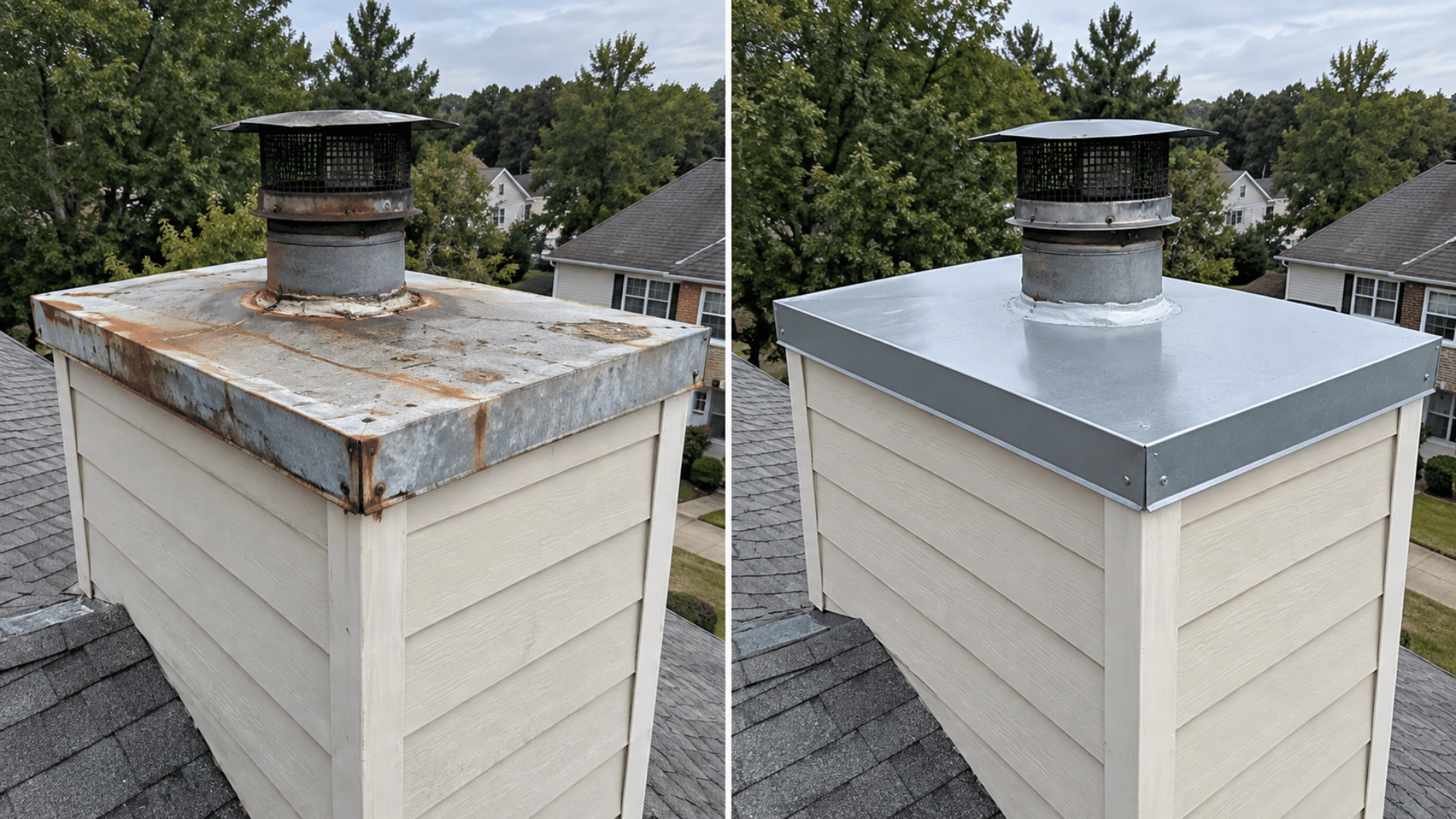
One of the easiest warning signs to spot from the ground is a reddish-brown streak running down the side of the chimney. If your chase cover is galvanized steel, the metal starts out with a protective zinc coating — as that coating deteriorates and corrosion reaches the underlying steel, rainwater washes rust off the cover and down the chimney exterior. Watch for orange or brown streaks, rust bleeding from corners, staining directly below the top edge, or corrosion around fasteners and the flue opening. A little discoloration doesn’t always mean there’s already a hole through the metal, but visible rust on a chimney chase cover is a reason to inspect it before the corrosion becomes perforation.
2. Water Dripping Into the Firebox
Drops of water, wet firewood, a damp grate, or puddles on the firebox floor all mean something above the fireplace is letting rain into the system. A failed chimney chase cover is one possibility — but it’s not the only one. Water entering the firebox can also come from a damaged rain cap, failed storm-collar sealant, a venting-system issue, or another opening near the top of the chase. That’s why we don’t recommend seeing a puddle and immediately ordering a new chase cover. Determine where the water is actually entering first.
3. Rust Inside the Fireplace
Sometimes the first visible damage isn’t outside — it’s inside. Look at the damper, the fireplace grate, metal firebox components, and the lower portions of the chimney system. If parts that normally stay dry start developing orange corrosion or pitting, water has likely been entering somewhere above. CSIA inspection guidance specifically includes checking for rust or other conditions that could affect fireplace or chimney operation. The chase cover isn’t the only possible cause, but rust inside the fireplace combined with rust streaks outside the chase is a combination we take seriously.
4. The Cover Is Sagging or Holding Water
This is one of the most important signs. A chimney chase cover should be designed to shed water, not hold it. If the center begins bowing downward, the top becomes a shallow metal bowl, and after every Atlanta thunderstorm, water collects in that low spot — what we call the ponding effect. Instead of drying shortly after the storm, that same section can stay wet for hours at a time. Over time, this shows up as increasing corrosion, soft or pitted metal, pinholes, and leaking seams, often with corrosion starting from the underside where you can’t see it. A properly fabricated cover commonly uses a cross-break — diagonal bends across the sheet metal that slightly raise the center and direct water toward the edges. If your chase cover looks like a birdbath after it rains, don’t just patch the rust spot. Fix the reason water is sitting there in the first place.
5. Cracked or Missing Sealant Around the Storm Collar
The flue pipe has to pass through the chase cover, and that transition needs real protection — typically a raised metal collar built into the cover with a storm collar around the chimney pipe above it, working like a miniature umbrella to direct water away from the opening. Over time, exterior sealant can dry, crack, shrink, or peel away, and Atlanta’s sun, rain, and temperature swings keep exposing that joint to weather. If the metal cover itself is still structurally sound and the only failure is the weather seal at the storm collar, this may be one of the few situations where a relatively small repair is genuinely appropriate.
6. Musty Odors or Moisture Damage Around the Chimney
A chase is essentially a framed cavity, which means a leak can stay hidden inside it for a long time. If water repeatedly enters through the top, it can wet the wood framing, sheathing, insulation, and drywall before anyone notices anything from inside the house. Homeowners may notice a damp or musty smell, ceiling discoloration, soft drywall, peeling paint, or moisture-related mold growth well before they ever see an actual drip. The stain on your ceiling may be the last part of the leak — not the first.
Why Chase Covers Fail So Often in Atlanta
Builder-Grade Galvanized Steel
Many prefabricated chimney systems were originally topped with relatively inexpensive galvanized sheet metal. Galvanized steel can work for a while, but once its protective coating deteriorates, the exposed steel underneath starts to corrode. When we’re replacing a failing chimney chase cover, we generally prefer a more corrosion-resistant material rather than installing the same vulnerable metal a second time.
Heavy Rainfall
Atlanta receives close to 50 inches of normal precipitation annually. That means a poorly sloped chase cover doesn’t experience standing water once or twice — it can experience it repeatedly, for years.
Leaves and Pine Needles
Atlanta’s mature tree canopy adds another layer to the problem. Leaves, pine needles, twigs, and other debris collect around chimney components, and wet debris acts like a sponge, holding moisture against the metal long after a storm has passed.
Poor Chase-Cover Geometry
A completely flat cover is far more likely to hold water once the sheet flexes, the center loses support, debris blocks drainage, or the metal begins sagging — which is why proper fabrication matters just as much as the material itself. Sometimes the metal isn’t rusted through at all, and the water is coming through the transition around the flue pipe instead — exactly why a competent inspection evaluates the whole top assembly, not just the obvious rust.
A Real Example From a Marietta Home
A homeowner in Marietta noticed a localized water stain and sagging drywall on the ceiling beside the chimney. Naturally, they assumed the roof was leaking and called a roofer. The shingles looked fine. The chimney flashing at the roofline looked fine. But the water kept coming back.
Once the chimney structure was inspected from roof level, the actual problem became obvious: the builder-grade galvanized chimney chase cover had sagged inward, and rainwater had been collecting in the center instead of running off. Underneath the surface corrosion were rust pitting, pinholes, hairline openings, and corrosion developing from the underside — the chase cover had effectively turned into a shallow bowl.
When the failed cover came off, the damage didn’t stop with the metal. The chase underneath was framed with wood, and water had been traveling through the top and running down inside that cavity for months. By the time enough water finally reached the drywall ceiling for the homeowner to notice, some of the framing had already begun to rot. At that point, putting roof tar over the metal wasn’t a repair — it was a delay tactic.
The correct fix: the damaged cover came off, the exposed chase structure was inspected, compromised framing was repaired, and a properly measured, custom-fabricated stainless chimney chase cover with real drainage geometry went on in its place. That solves the cause instead of hiding the symptom.
Chimney Chase Cover Repair vs. Replacement: How We Decide
One of the most common questions we get is: can you just repair the one I already have? Sometimes — but not nearly as often as people hope.
When Repair Makes Sense
A repair may be the right call when the storm-collar seal has failed but the metal pan itself is still solid, with no sagging or significant corrosion — removing the failed sealant and resealing the joint can resolve the problem on its own. It also makes sense when a fastener has simply loosened in the wind but the metal remains structurally sound, or when there’s only very minor surface corrosion that can be cleaned and protected. We generally treat that last one as a temporary maintenance measure, though, especially on an aging galvanized cover — it buys time, not permanence.
When Replacement Is the Right Call
Full replacement is usually the smarter move when the center is already sagging and holding standing water — sealant on rust spots doesn’t correct a shape that’s already failed. The same goes for pinholes (corrosion has already eaten through the sheet metal at that point), metal that feels soft or deeply pitted, rust that’s widespread across the cover, a cover that’s visibly warped or lifted from wind or age, or any case where water has already reached the framing inside the chase. Once water’s reached that point, we want the failed cover removed so the structure underneath can actually be evaluated — not covered up again.
What a Proper Replacement Chimney Chase Cover Should Include
This is where homeowners can avoid installing the same problem twice. A quality replacement isn’t simply a flat piece of metal with a hole cut through it.
Our preferred material is custom-fabricated stainless steel — far more corrosion-resistant than galvanized, and the better long-term investment rather than replacing thin, vulnerable metal every few years. Copper is also an excellent premium option, particularly on homes that already use architectural copper elsewhere. Beyond the material itself, a quality chimney chase cover should have a cross-break — diagonal creases that slightly elevate the panel and direct water toward the edges instead of letting it pool in the center — a raised flue collar that gives water a real vertical barrier before it can reach the pipe opening, rather than a flat hole cut straight through the pan, a proper side skirt that extends well down over the upper edge of the chase (not just a thin lip that barely covers the siding), a real drip edge that breaks water’s path so it falls away instead of curling back underneath the metal, and a storm collar that’s replaced along with the cover rather than reused — a beautiful new chase cover installed with a distorted old storm collar still leaves the chimney vulnerable at the exact spot you’re trying to protect.
A few shortcuts tend to undo all of this, even on an otherwise good installation: screwing straight through the horizontal top instead of fastening through the vertical skirt (every unnecessary penetration through a water-shedding surface is a potential leak point), cutting a flat hole around the flue instead of using a raised collar, and making the skirt too short to actually protect against wind-driven rain. Ask directly what skirt and drip-edge design your contractor is installing — the answer tells you a lot more about the job than the price alone.
One note on the specific numbers you might see online — 24-gauge stainless, a 3-inch skirt, a 1/2-inch drip edge, a 2-inch raised collar — these are common fabrication specs used by several professional suppliers, not a universal code requirement. The correct chimney chase cover still has to be designed around your specific fireplace manufacturer, chimney pipe, required clearances, number of flues, and actual field measurements. We don’t recommend ordering metal from an internet diagram without first verifying the venting system in person.
What a Proper Replacement Process Looks Like
Inspect, Then Measure the Actual Chase
Before ordering any metal, we inspect the rust, sagging, seams, fasteners, storm collar, rain cap, flue pipe condition, and exterior siding, along with any evidence of interior leakage — if the problem turns out to be only a failed seal, full replacement may not even be necessary yet. When replacement is the right call, we measure the structure itself rather than blindly copying dimensions from a warped old cover: all four sides, flue diameter and position, number of penetrations, and the clearance the fireplace manufacturer actually requires. If there’s reason to suspect deeper damage, a full chimney inspection may be worth scheduling before any metal gets ordered.
Remove the Old Cover and Inspect the Hidden Framing
This is one of the most important moments of the job, because removing the failed chase cover is the only way to see what’s actually underneath it. We look for rot, water staining, deteriorated sheathing, soft framing, mold-related moisture, and any damage around the chimney penetration — and repair whatever’s compromised before closing the chase back up. Putting a beautiful stainless cover over rotten framing isn’t a quality repair, no matter how good the metal looks from the yard.
Install the New Cover, Storm Collar, and Rain Cap
The new chimney chase cover seats correctly over the chase and gets mechanically secured in a way that doesn’t create unnecessary water-entry points through the horizontal pan — we generally prefer fastening through the vertical skirt rather than driving exposed fasteners downward through the water-shedding top. The storm collar is then correctly fitted around the chimney pipe, the appropriate weather seal applied, and the rain cap secured.
Document the Work
Homeowners should be able to see the old cover, any rust or holes, the hidden damage we found, the repairs completed, and the finished installation. Photos matter here because most homeowners are never going to stand beside their own chimney and see any of this firsthand.
Chase Cover Leak, or Something Else?
Water is frustrating because it travels — the stain may appear six feet from the actual opening. Still, there are clues that point toward one component over another.
| If You See | The Likely Source |
|---|---|
| Rust streaks down the chase exterior, visible ponding or sagging, dripping that continues after the rain stops | The chimney chase cover itself |
| Moisture where the chase meets the roof, wet roof decking, leakage mainly while rain is actively falling | Roof flashing |
| Water tracking directly down the outside of the round chimney pipe, worse in wind-driven rain | The storm collar |
| Water falling almost straight into the flue, dripping or splashing heard inside the chimney | The rain cap |
| Leaks only on one specific side during windy storms | Siding, trim, or another opening in the exterior finish |
We don’t recommend standing in someone’s living room, seeing a ceiling stain, and announcing they need a new chimney chase cover. Before recommending replacement, we want real evidence — a roof-level inspection, photos, attic inspection where it’s accessible, and a close look at the storm collar, the cover itself, the base flashing, and the siding. The goal isn’t to sell the most expensive repair. It’s to stop the actual water entry. If you’re not sure whether what you’re seeing is the chase cover or something else entirely, our guide on why chimneys leak water inside covers the broader diagnostic picture.
How Much Does Chimney Chase Cover Repair Cost in Atlanta?
| Project | Typical Starting Range |
|---|---|
| Storm-collar / sealant repair | $150 – $350 |
| Galvanized chase-cover replacement | $400 – $900 |
| Custom stainless-steel chase cover | $800 – $1,800 |
| Custom copper chase cover | $1,500 – $2,500+ |
These are planning ranges, not fixed quotes — your final cost depends heavily on the property itself. A few things commonly push the price up: hidden wood rot found once the old cover comes off (probably the biggest surprise homeowners run into), roof height and pitch (a one-story ranch and a steep three-story home are completely different access situations), the size of the chase and how many flues it has to accommodate, whether you choose copper over stainless, and any additional components needed — a new storm collar, rain cap, siding repair, or other chimney-system work. Those should always be itemized rather than buried inside a vague “chimney repair” line.
Galvanized, Stainless, or Copper — Which Material?
Galvanized Steel
The lower-cost, widely available option. It can work fine for a while, but once its protective coating deteriorates, exposed steel starts to corrode — particularly problematic if the cover also holds standing water instead of shedding it.
Stainless Steel
Far more corrosion-resistant than galvanized, and commonly available in heavy-gauge chimney chase cover systems with long manufacturer warranties against corrosion. If we’re already removing a failed galvanized cover, we generally recommend upgrading rather than installing essentially the same vulnerable material a second time. For most Atlanta homeowners planning to stay in the home, stainless is our preferred balance of durability and cost.
Copper
The premium option, especially attractive on higher-end homes, historic architecture, or houses that already have copper gutters, roof valleys, or other decorative metalwork. Instead of developing orange steel rust, copper develops a natural patina over time. It costs considerably more than stainless, but it can be a genuinely excellent architectural choice where it fits the house.
Can You Check Your Chimney Chase Cover From the Ground?
Yes — and that’s exactly where homeowners should start. Don’t climb onto a steep roof just to inspect a chase cover yourself. Walk into the yard and use binoculars, your phone’s zoom, or a camera with a telephoto lens, and look for rust streaks, sagging, bent edges, a missing cap, leaning components, or debris buildup. Then check inside for rust, moisture, water staining, a musty odor, or damp drywall. If you’re seeing both exterior rust and interior water signs together, it’s time for a closer professional look.
What Chimney Chase Cover Repair Won’t Fix
Fixing or replacing the chase cover solves water entry at the very top of the chase — it doesn’t automatically solve everything connected to it. Chimney chase cover repair on its own won’t fix:
- A failing rain cap. The cap and the chase cover are different components doing different jobs — a damaged rain cap needs its own repair even after the cover is handled.
- Roof flashing where the chase meets the roof. If water is actually entering at the roofline, treating the chase cover has no effect — see our guide on chimney flashing problems for that separate repair.
- Already-rotted framing underneath. New metal on top doesn’t undo rot that’s already happened inside the chase — that structural work has to happen before the new cover goes on, not instead of it.
- Water entering through damaged siding or trim. Some leaks only show up when wind drives rain against one specific side of the structure, and that’s an exterior-finish repair, not a chase-cover repair.
- Interior water damage that’s already occurred. Stained ceilings, soft drywall, or a musty smell from water that already got in need their own remediation, separate from stopping the leak itself.
If you’re not sure which of these actually applies to your chimney, a proper inspection is the way to find out before paying for a repair that doesn’t address everything that’s wrong.
How to Choose the Right Chimney Company
It depends partly on where the leak actually originates. A roofer is the right call when the problem is clearly the roofing, decking, shingles, or the flashing system itself. But if the problem looks related to the chase cover, storm collar, chimney cap, or another factory-built chimney component, we recommend having the chimney system evaluated by a qualified chimney professional specifically — CSIA maintains certification programs for chimney professionals, and NFPA 211 is the broader industry standard technicians are trained against. (NFPA 211 is a standard, not a technician certification itself — a distinction worth knowing when you’re evaluating a contractor’s claims.)
Before approving a new chimney chase cover, ask more than “how much?” Ask what material they’re using and what gauge, whether it’s custom measured for your specific chase, whether the top has a cross-break for positive drainage, how tall the skirt is, whether there’s a formed drip edge and a raised flue collar, whether they’re replacing or reusing the storm collar, whether they’ll remove the existing cover and inspect the framing underneath before installing anything new, and what warranty actually applies to the product being installed.
Beyond those questions, look for the same baseline credentials that matter for any chimney work:
- CSIA certification — the Chimney Safety Institute of America sets the industry’s recognized training standard
- Proof of insurance — protects you if something goes wrong on your property
- BBB accreditation — a verifiable track record, not just a promise
- Willingness to show you evidence — photos of the old cover, the hidden damage found, and the finished work, not just a verbal description
Final Answer
A water stain near your fireplace doesn’t automatically mean a roof leak — on a prefab chimney, it’s often the chimney chase cover several feet above the roofline. If the metal pan is still structurally sound and the only failure is a secondary seal, repair can genuinely be enough. If the metal is sagging, perforated, extensively rusted, or warped, replacement is almost always the smarter long-term call. And whenever a failed cover comes off, the framing underneath should be inspected before a new one goes on — that hidden step matters more than the shiny stainless everyone sees afterward.
Final Advice From Our Team
This depends on the chimney — but don’t wait until your ceiling turns brown to look up. The next time you’re outside, take thirty seconds and actually look at the top of your chimney. Rust streaks, a sagging top, bent metal, or deterioration around the flue are all reasons to schedule an inspection before the next heavy storm exposes the weakness further. And if anyone offers to fix a badly rusted chimney chase cover by smearing it in roof tar, ask them to show you the condition of the metal underneath first.
Call (470) 706-6431 or contact us to schedule a chimney chase cover inspection in Atlanta, GA.
FAQ
What is the difference between a chimney cap and a chase cover?
A chase cover spans the entire top of a framed chimney chase. A chimney cap, or rain cap, protects the opening of the flue itself. They do different jobs, and many prefabricated systems need both.
Can I just caulk a rusted chase cover?
If the only problem is failed sealant around an otherwise sound assembly, resealing may make sense. If the metal is rusted through, sagging, soft, or full of pinholes, caulk isn’t a structural repair.
How do I know if my chase cover has holes?
Sometimes you can see obvious holes. More often, the first evidence is rust pitting, water showing up inside, rust staining, sagging, or corrosion visible from below once the cover is removed. Small pinholes can be genuinely hard to spot from the ground.
Does a rusted chase cover need to be replaced immediately?
Surface rust alone doesn’t always mean emergency replacement. But once corrosion becomes deep, widespread, or perforates the sheet metal, replacement becomes much more reasonable than repeated patching.
Can a chase cover leak damage the house?
Yes. Because the chase contains wood framing, water can affect the structure before it ever reaches a visible interior finish — which is why an active leak shouldn’t be ignored.
Is stainless steel worth the extra cost?
For most of the chimney chase cover replacements we recommend in Atlanta, yes. The additional upfront cost tends to make sense compared with repeatedly repairing or replacing corrosion-prone sheet metal every few years.
How long does a stainless chase cover last?
There isn’t one guaranteed lifespan that applies to every installation — material quality, fabrication, environment, and chimney design all play a role. Some manufacturers offer long corrosion warranties on stainless chase covers, but it’s worth reading the specific written warranty rather than assuming every stainless cover carries the same guarantee.