Skip to content

If you notice cracks inside your fireplace, crumbling firebricks, missing mortar, or rust on the metal panels, your firebox may need professional repair. Some problems can be fixed with relatively minor masonry work. Others call for replacing refractory panels, rebuilding the firebox, or replacing a damaged factory-built fireplace — which is why firebox repair in Atlanta should start with an accurate diagnosis, not a guess.
Here’s what many homeowners don’t realize: a small crack inside your fireplace doesn’t always mean the damage is small. The firebox is the chamber where the fire burns, and its job is to withstand repeated heat as part of a properly designed fireplace and venting system. When its protective materials deteriorate, the problem can go well beyond appearance.
At Clean Air Duct Cleaning & Chimney, we see cracked firebrick, deteriorating refractory mortar, damaged prefabricated panels, and water-related corrosion in fireplaces across Atlanta, Sandy Springs, Roswell, Marietta, Alpharetta, Dunwoody, Brookhaven, Decatur, and Smyrna. We’ve seen homeowners expect a quick cosmetic patch and find much more extensive deterioration. One memorable call in Marietta involved a few flakes of brick and a small crack along the back wall of the fireplace. The homeowner expected a minor fix. Our technician found that much of the rear firebox mortar had deteriorated and several firebricks needed replacement.
In this guide, we’ll cover the 7 warning signs your firebox needs repair or replacement, what causes the damage, how much firebox repair costs in Atlanta in 2026, when to stop using your fireplace, and how to avoid an unnecessary replacement.
Table of Contents
- What Is a Firebox, and Why Does Firebox Repair Matter?
- 7 Signs You Need Firebox Repair
- A Real Example From a Marietta Home
- What Causes Firebox Damage in Atlanta?
- Firebox Repair vs. Replacement: Which Is Better?
- How Much Does Firebox Repair Cost in Atlanta in 2026?
- How Professionals Inspect Firebox Damage
- What a Professional Firebox Repair Includes
- When to Stop Using a Damaged Firebox
- What Firebox Repair Won’t Fix
- Why DIY Firebox Repair Often Backfires
- How to Prevent Expensive Firebox Repairs
- How to Choose the Right Chimney Company
- Final Answer
- Final Advice From Our Team
- FAQ
What Is a Firebox, and Why Does Firebox Repair Matter?
The firebox is the interior chamber of a fireplace where wood or another approved fuel burns. In a traditional masonry fireplace, it’s built from specially manufactured firebrick bonded with refractory mortar — materials designed to handle the repeated high temperatures of a wood fire. In a factory-built (prefabricated) fireplace, the firebox is usually a metal structure lined with manufactured refractory panels, which have to meet the requirements of that specific fireplace system.
That’s why firebox repair matters: when those protective materials crack, crumble, or corrode, the fireplace may no longer perform the way it was designed to.
| Feature | Masonry Firebox | Prefabricated Firebox |
|---|---|---|
| Construction | Site-built brick and refractory mortar | Factory-manufactured metal unit |
| Interior protection | Firebrick and mortar | Manufactured refractory panels |
| Common damage | Cracked brick, failing mortar, spalling | Cracked panels, corrosion, warping |
| Typical repair | Repointing or replacing firebrick | Replacing approved components |
| Replacement considerations | Extent of structural masonry damage | Manufacturer approval, shell condition, parts availability |
Why does the distinction matter? Because firebox repair on a masonry fireplace isn’t the same as repairing a factory-built one. A mason may be able to replace a single damaged firebrick, but a cracked refractory panel in a listed factory-built unit generally has to be repaired or replaced following the manufacturer’s approved instructions. An unsuitable material can create new problems instead of fixing the old one.
7 Signs You Need Firebox Repair
Firebox damage develops gradually. Some signs are obvious, like large cracks or missing bricks; others are easy to overlook until the problem gets worse. These are the seven we look for when a homeowner calls about firebox repair in Atlanta.
1. Cracked or Deteriorating Mortar Joints
One of the most common problems in masonry fireboxes is deteriorating refractory mortar. It fills the joints between firebricks and is part of the firebox’s protective construction, and after years of heating, cooling, moisture, and normal use, it can weaken. Watch for thin cracks between firebricks, recessed or missing mortar, sandy or powdery material on the firebox floor, deep gaps along the back or side walls, or mortar that breaks apart easily.
A little surface wear doesn’t mean the whole fireplace needs rebuilding, but open joints and extensive deterioration deserve a professional look — depending on the construction, they can also point to deeper masonry problems. When the surrounding brickwork is sound, a technician can remove the deteriorated mortar and replace it with a suitable refractory mortar. That’s commonly called firebox repointing, and it’s the most affordable kind of firebox repair when it’s done properly. A thin coat of new mortar over loose or contaminated material isn’t a structural repair. If mortar is falling out from between your firebricks, avoid using the fireplace until the extent of the deterioration has been evaluated.
2. Spalling, Crumbling, or Cracked Firebricks
Firebrick is made to withstand the conditions inside a fireplace, but it can still deteriorate. One common form is spalling, where the face of a brick flakes, chips, or breaks apart — often from repeated heating and cooling, moisture, thermal stress, impacts from logs or tools, aging, or earlier improper repairs. Moisture deserves special attention in Atlanta: if water enters through a damaged crown, missing cap, or bad flashing, repeated wetting and drying can speed up deterioration inside the firebox.
Look for peeling or flaking brick faces, deep cracks across firebricks, loose fragments in the firebox, bricks moving out of position, or pieces separating from the rear wall. If damage is limited to one or several bricks and the surrounding structure is sound, firebrick replacement may be all that’s needed — the damaged bricks are carefully removed and replaced with compatible firebrick and refractory mortar. If an entire wall is bowing, many bricks are loose, or the supporting masonry is deteriorating, part or all of the firebox may need rebuilding, so the right firebox repair depends on how far the damage goes. A useful rule: replacing a damaged brick can be practical; trying to hold an unstable firebox wall together with fresh mortar is not.
3. Rust, Corrosion, or Holes in Metal Components
Atlanta’s heavy rain and humidity also drive corrosion inside fireplace systems, especially factory-built ones with metal components that persistent moisture can damage. Technicians commonly find rust on dampers, metal firebox shells, throat components, retaining brackets, and metal floor sections. The water usually comes from a missing or damaged chimney cap, a deteriorated crown, a leaking chase cover, or defective flashing, and once it’s in, it can sit around the lower fireplace components.
A little surface staining doesn’t necessarily mean replacing the whole fireplace. Deeper corrosion can mean metal thinning, pitting, warping, holes, failed mounting points, or parts that no longer work — and on a factory-built unit, serious damage to the metal shell can mean replacing individual panels isn’t enough. If you see rust inside your fireplace, find out where the moisture is coming from first, then do the firebox repair. Otherwise the corrosion can continue after the damaged part is replaced. Our guide to chimney waterproofing covers how to stop water at the source.
4. Smoke Backing Up Into Your Living Room
If smoke enters the living room while the fireplace is running, stop using it until the cause is found. Smoke backup can come from a partially blocked chimney, negative air pressure, a cold flue, a malfunctioning damper, venting design problems, or damaged or incorrectly installed components. It doesn’t necessarily mean the firebox itself is damaged, since the problem may be higher in the chimney — but it does mean the whole fireplace and venting system deserve attention, and our guide on why fireplaces smoke into the house covers the common causes.
It’s also a safety issue. Improper venting can expose people to combustion products, including carbon monoxide, which is odorless — you can’t rely on smell to know whether it’s present. If a CO alarm sounds or anyone has possible poisoning symptoms, move to fresh air and get emergency help. And don’t keep trying to restart a fireplace that’s smoking into the home. Have the cause diagnosed.
5. Persistent Odors, Water Stains, or Moisture Damage
An unusual fireplace odor can be an early sign that water is reaching the firebox or nearby materials. Homeowners may notice a damp basement smell, sour odors after heavy rain, rust stains near the damper, white mineral deposits on brick, moisture on the firebox floor, staining around the opening, or water marks on nearby drywall. Persistent moisture can contribute to deteriorating mortar, rusted metal, damaged brick surfaces, and corrosion around mounting hardware.
None of that automatically means the firebox needs replacing, but the fireplace should be evaluated along with the chimney’s water-protection components: the cap, crown, flashing, exterior mortar joints, and chase cover. A firebox repair that ignores the water source can fail the same way again. Related reading: Why Does My Chimney Smell Bad? 7 Common Causes.
6. Decreased Performance or Unusual Operation
A fireplace that suddenly operates differently deserves attention: difficulty starting a fire, poor draft, excessive smoke, unusual overheating, reduced performance, or ignition and operating problems on a gas fireplace. These aren’t always firebox problems. The firebox, chimney, flue, combustion-air supply, damper, and any connected appliance components all work together, and trouble in one can show up in another.
Gas fireplaces and inserts are different from wood-burning fireboxes. Unexpected shutdowns, unusual odors, ignition trouble, or abnormal operation may involve gas controls, burners, sensors, or venting, and need a qualified professional familiar with the appliance. Don’t assume a refractory panel replacement will fix a gas fireplace performance problem before the system has been diagnosed.
7. Cracked, Loose, or Deteriorating Refractory Panels
Many newer Atlanta homes have factory-built fireplaces that use refractory panels along the rear wall, side walls, and floor. The panels may have a brick pattern, but they aren’t the same as individual masonry firebricks. Over time they can develop surface cracks, larger fractures, loose or missing pieces, deep erosion, crumbling edges, gaps between panels, or exposed metal behind the refractory.
Are hairline cracks normal? Some factory-built fireplace manuals treat minor expansion-related cracking as normal. You’ll often hear a “dime-width” rule of thumb, but there’s no universal rule for every model — some manufacturer manuals call for replacement when cracks exceed 1/4 inch, when metal is exposed, or when large pieces fall out. The instructions for your specific fireplace model take priority.
Minor conditions can sometimes be handled per the manufacturer’s instructions, but damaged panels often need refractory panel replacement. A contractor should identify your fireplace’s manufacturer and model before any firebox repair or part selection. If the correct panels are discontinued, the technician has to determine whether a manufacturer-approved alternative exists, and if the fireplace can’t be restored with compatible components, replacing the whole unit may become necessary. Never choose a replacement panel just because it looks similar or physically fits.
A Real Example From a Marietta Home: The Firebox Repair That Looked Minor
One of the most memorable firebox repair calls our team has handled involved a two-story colonial in Marietta. The homeowner scheduled a routine seasonal fireplace maintenance visit with one concern: a small amount of crumbling brick material and what looked like a hairline crack on the rear wall of the firebox. They only burned a few logs at a time, the exterior masonry looked normal, and they assumed the crack could be sealed with a bit of mortar.
What Our Technician Found
Looking more closely at the back wall of the masonry firebox, our technician found the damage was more extensive than it looked. Several firebricks showed significant spalling, and the refractory mortar had deteriorated to the point that portions crumbled under light professional examination. What appeared to be a superficial crack was tied to deeper deterioration of the firebox wall. The concern was no longer how the bricks looked, but whether the deteriorated materials could keep doing their protective job.
The Repair
Fortunately, the surrounding masonry was sound enough for targeted restoration. The work involved:
- Removing the damaged firebricks
- Preparing the deteriorated mortar joints
- Replacing the compromised firebricks with compatible materials
- Rebuilding the affected rear-wall joints with appropriate refractory mortar
- Evaluating the completed work before the fireplace returned to use
A project with extensive firebox repointing and localized brick restoration like this may fall around $600–$1,500, depending on scope. The exact customer invoice isn’t included here — that range is a representative estimate for similar work.
Rather than replacing the fireplace, the affected protective masonry was restored, and the homeowner got a clear explanation of the damage and the work done. The lesson: the visible size of a firebox crack doesn’t tell you how much material behind it has deteriorated — but a visible crack isn’t automatically proof of catastrophic failure either. The right firebox repair depends on inspecting the actual materials and construction.
What Causes Firebox Damage in Atlanta?
Understanding the cause matters, because a firebox repair that ignores the cause tends to fail again.
Water Intrusion
Water is a major contributor to masonry and metal deterioration. Rain can enter through a missing cap, deteriorated crown, damaged flashing, or another chimney defect, and repeated moisture exposure can weaken some masonry materials and drive corrosion.
Oversized Fires
Fires larger than the fireplace was designed for increase thermal stress and can damage refractory components, metal parts, and other materials. Always follow the fireplace manufacturer’s operating instructions — and see our guide to chimney fire prevention for safe burning habits.
Repeated Temperature and Moisture Changes
Fireboxes expand and contract constantly. When the materials have also absorbed moisture, those temperature swings can contribute to cracking or spalling, and Atlanta’s wet stretches and occasional freezes make moisture control especially important.
Improper Fuel and Burning Practices
Wet or unseasoned wood produces more smoke and can add to creosote buildup, and burning trash, treated wood, or construction scraps creates additional hazards.
Structural Movement
Settlement or movement in the underlying construction can contribute to cracking, and some Atlanta-area soils change in moisture content in ways that affect foundations. But a firebox crack alone doesn’t prove foundation movement. The cause has to be investigated, not assumed.
Firebox Repair vs. Replacement: Which Is Better?
The biggest decision homeowners face is whether to repair individual components or replace a larger section of the fireplace. Firebox repair or replacement depends on the fireplace type, the extent of deterioration, the condition of the supporting structure, the availability of compatible materials, manufacturer requirements, the underlying cause, and the overall cost.
| Condition | Repair May Be Appropriate | Replacement May Be Necessary |
|---|---|---|
| Minor mortar deterioration | Repoint affected joints | When deeper structural failure exists |
| One or two broken firebricks | Replace the affected bricks | When extensive masonry is unstable |
| Localized refractory panel damage | Replace the approved panel | When no compatible repair is available |
| Rusted damper | Repair or replace the component | When wider system damage is present |
| Bowing masonry wall | Usually needs structural reconstruction | Often a partial or complete rebuild |
| Warped factory-built shell | Limited approved repairs may be possible | The entire listed unit may need replacement |
| Repeated damage after repairs | Reassess the cause and repair scope | Consider rebuilding or unit replacement |
When Repair Is the Smarter Investment
- The damage is localized and the surrounding masonry is sound
- The fireplace hasn’t shifted structurally
- Approved replacement components are available
- The underlying cause can be corrected
When Replacement Makes More Sense
- A masonry firebox wall is severely unstable, or cracking involves the supporting structure
- Factory-built metal components are badly warped or perforated
- Required replacement parts are unavailable
- Earlier repairs keep failing because the underlying condition was never corrected
- The system can’t be restored in line with applicable requirements
The biggest financial mistake is choosing a cheaper patch without understanding the condition of the firebox — a $400 repair isn’t a bargain if the materials underneath are already failing. But replacing a whole fireplace when only one approved panel needs replacing is an unnecessary expense too. The goal is the least extensive firebox repair that adequately addresses the actual defect.
How Much Does Firebox Repair Cost in Atlanta in 2026?
Firebox repair costs vary with the type of fireplace, how much material is damaged, and how much work is involved. A localized mortar repair can cost a few hundred dollars; extensive masonry reconstruction or replacing a factory-built fireplace can cost several thousand.
| Firebox Repair Service | Estimated Starting Range |
|---|---|
| Firebox mortar repair / repointing | $250 – $800 |
| Firebrick replacement | $400 – $900 |
| Refractory panel replacement | $360 – $750 |
| Firebox floor / hearth repair | $155 – $805 |
| Damper repair or replacement (see our damper guide) | $100 – $700 |
| Full masonry firebox rebuild | $1,500 – $3,500+ |
| Full prefabricated fireplace replacement | $2,500 – $7,000+ |
These are approximate 2026 Atlanta-area planning ranges, not guaranteed prices, statistically verified market averages, or maximum project costs. Major structural complications, appliance compatibility requirements, and related chimney work can raise the total substantially.
What Pushes Firebox Repair Costs Up
- Hidden damage. What looks like a localized crack may extend into more mortar joints or bricks, and more material may need to come out before sound construction can be restored.
- Multiple damaged firebricks. Replacing two bricks is a different job than reconstructing an entire rear wall.
- Specialized refractory materials. Not every masonry mortar, refractory cement, or replacement brick is suitable for a firebox.
- Discontinued prefabricated parts. If the manufacturer no longer supplies panels or components, finding an acceptable repair gets more complicated.
- Related chimney problems. Crown damage, water intrusion, liner problems, smoke chamber defects, and structural masonry deterioration may coexist with firebox damage and need their own repairs.
- Labor and access. Demolition, dust containment, preparation, and rebuilding take far longer than a small localized repair.
Ask for an itemized firebox repair estimate explaining which parts of the fireplace need work and why. For related costs, see our 2026 chimney repair cost guide for Atlanta.
How Professionals Inspect Firebox Damage
At Clean Air Duct Cleaning & Chimney, the inspection starts with the visible condition of the firebox. The goal is to find out whether the damage is superficial, localized, or part of a more serious defect.
1. Inspect the Back Wall and Firebrick
The technician looks for cracks, deep surface erosion, spalling, loose bricks, missing sections, displacement or bowing, and signs of overheating. The back wall gets particular attention because it takes substantial heat.
2. Evaluate the Mortar Joints and Firebox Floor
The inspector checks for deteriorating or missing mortar, and gentle examination can help identify loose material. But tapping a brick or probing mortar can’t independently establish that the firebox is structurally safe, so if concealed damage is suspected, further evaluation may be needed. The floor gets checked for cracked bricks, settling, and moisture. The interior firebox floor and the hearth extension in front of the fireplace are different components, and damage to either may call for a different repair method.
3. Identify the Fireplace Type
For factory-built systems, the technician should locate the manufacturer, model, serial number, applicable installation or service manual, and replacement component details. That information determines which repairs and parts are appropriate.
4. Evaluate Related Chimney Conditions
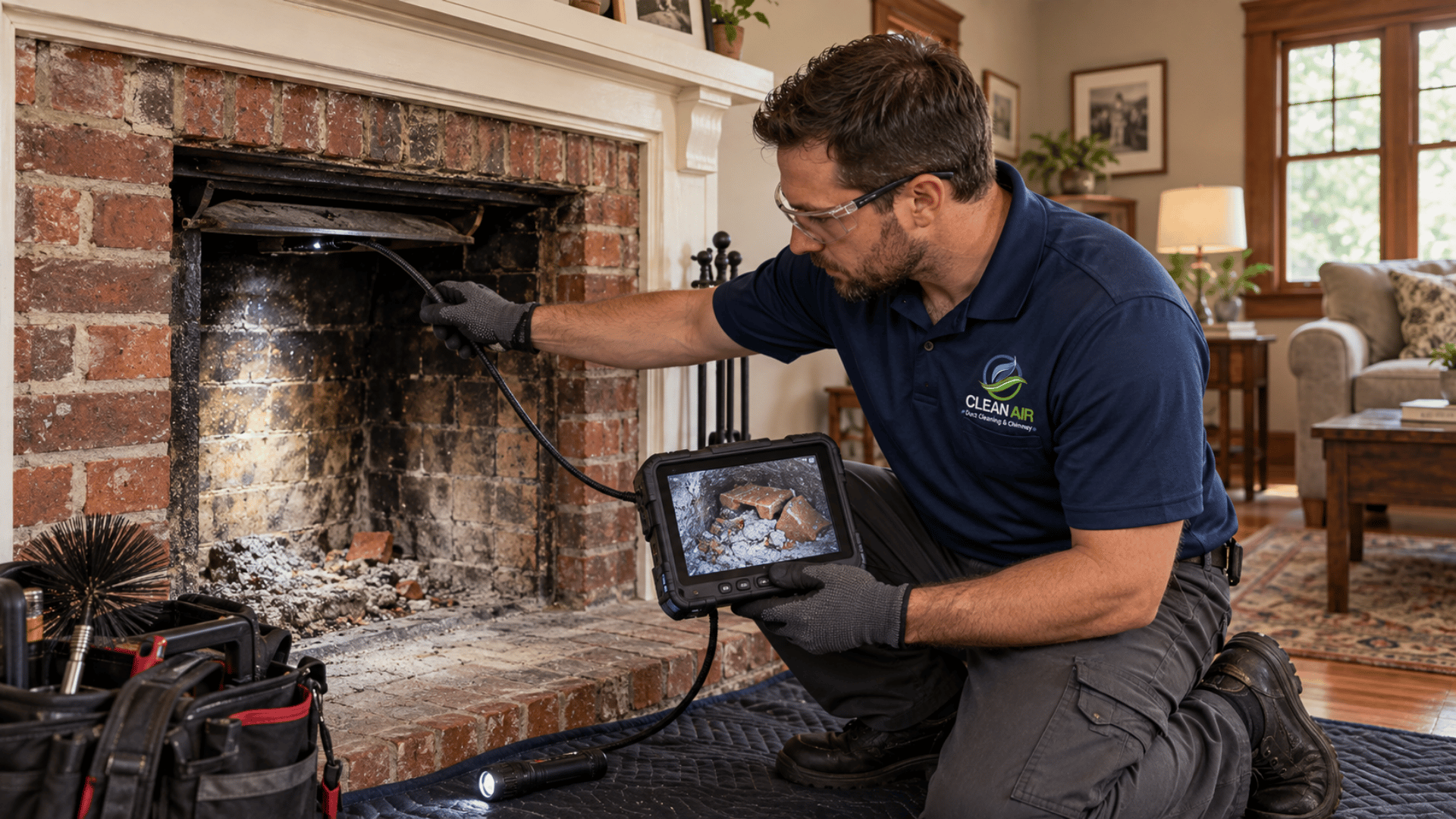
When visible firebox damage suggests a problem with the smoke chamber or flue, a more comprehensive inspection may be appropriate. An internal camera inspection can document flue liner surfaces, cracked clay tiles, missing joints, water staining, and internal obstructions. A Level 2 inspection fits certain situations — after a damaging event, when equipment changes, or when a Level 1 can’t establish the system’s serviceability — but it isn’t automatically required for every small firebox crack. See our guide to the three chimney inspection levels for the details.
5. Document the Findings
You should get an explanation of what’s damaged, why it matters, whether repair or replacement is appropriate, what else should be investigated, and what the recommended work includes, with photographs or camera documentation where relevant. A major firebox repair recommendation should be supported by evidence, not just a verbal claim that the fireplace is unsafe.
What a Professional Firebox Repair Includes
Homeowners often ask whether firebox repair is messy, how long it takes, and when they can use the fireplace again. Here’s what a typical professional masonry firebox restoration involves, and it’s the same standard of work behind our fireplace repair service.
Protect the Home
Before work starts, technicians may put down floor protection, drop cloths, containment sheeting, and dust extraction equipment, and cover surrounding surfaces. When masonry is being cut or removed, respiratory protection and dust control matter.
Remove Deteriorated Materials
Depending on the repair, that can mean removing failed mortar from the joints, carefully taking out damaged firebricks, clearing loose debris, preparing the remaining masonry, and cleaning surfaces for the repair material. How deep the mortar comes out depends on the condition of the joint and the repair system — it isn’t a fixed measurement for every firebox.
Install Compatible Repair Materials
For masonry fireplaces, that means suitable refractory mortar, repointing the prepared joints, installing replacement firebricks, rebuilding damaged wall sections, and tooling the joints. For prefabricated fireplaces, it means installing approved replacement panels or components according to the manufacturer’s instructions.
Final Evaluation, Cleanup, and Curing
The technician checks the completed work, cleans up, and explains the condition of the fireplace. Depending on the scope, the connected venting system may need verification before the fireplace is used again. Curing matters most for masonry work: different refractory products have different requirements, and some need controlled drying and gradual heat. There’s no universal 21–28-day waiting period for every refractory mortar or any firebox repair. The contractor should give you written instructions for the specific product and work performed.
How Long Does It Take?
A small localized repair may be done in one visit. Extensive brick replacement or structural rebuilding may take additional appointments, and the full timeline includes preparation, removal, reconstruction, cleaning, required drying or curing, and final verification. Don’t judge the quality of a firebox repair by how fast the contractor finishes. Proper preparation, materials, and curing matter more.
When to Stop Using a Damaged Firebox
Not every surface crack means replacing the fireplace, but some conditions make continued use inappropriate until the system has been professionally evaluated. Stop using the fireplace if you notice:
- Loose or missing firebricks
- Deep cracks or open mortar joints suggesting structural deterioration
- Bowing or displaced masonry walls
- Crumbling refractory panels, or metal exposed behind damaged panels
- Significant rust-through or metal warping
- Smoke entering the room, or unusual overheating around the fireplace
- Known or suspected damage after a chimney fire
What about small hairline cracks? Minor surface cracking may be acceptable in some fireplace systems, especially when the manufacturer allows it. But crack width alone doesn’t establish whether the fireplace is safe. Material condition, crack depth, location, component stability, and the system’s design all matter.
| Condition | Recommended Action |
|---|---|
| Minor surface discoloration | Routine evaluation during maintenance |
| Small crack in a refractory panel | Check manufacturer limits and get an assessment |
| Slight mortar wear with no open gaps | Schedule a professional evaluation |
| Loose or falling firebricks | Stop use until evaluated |
| Open structural gaps or unstable masonry | Stop use until repaired and evaluated |
| Exposed metal behind damaged prefab panels | Stop use until evaluated |
| Smoke backing into the room | Stop use and diagnose the venting problem |
| Suspected active chimney fire | Evacuate and call 911 |
An active fire, heavy smoke, or signs of carbon monoxide exposure calls for emergency action, not a routine service appointment — and nothing gets fixed until it’s safe to use, so don’t schedule any firebox repair around a fireplace that’s still being lit. The NFPA’s home heating safety guidance covers what to do.
What Firebox Repair Won’t Fix
Repairing the firebox restores the chamber where the fire burns. It doesn’t automatically fix the systems connected to it. Firebox repair on its own won’t fix:
- The water source behind the damage. If rain is entering through a cracked crown, missing cap, bad flashing, or failing chase cover, new firebrick or panels can deteriorate the same way again.
- A damaged flue liner or smoke chamber. A firebox repair doesn’t touch the flue above it — liner damage needs its own evaluation (see chimney liner damage).
- Draft, smoke backup, or pressure problems. These often start higher in the chimney or in the home’s airflow, not in the firebox.
- Gas fireplace operating problems. Gas controls, burners, sensors, and appliance-specific venting need a qualified appliance technician.
- A damaged damper. It’s its own component with its own repair (see chimney damper repair).
- Overfiring and bad burning habits. New brick won’t survive oversized fires or wet-wood burning any better than the old brick did.
If you’re not sure which of these apply, an inspection is how you find out before paying for a repair that doesn’t address everything that’s wrong.
Why DIY Firebox Repair Often Backfires
One of the biggest homeowner mistakes is using ordinary household mortar or general-purpose patching compound inside a firebox. A fireplace isn’t an exterior brick wall — the materials face repeated high temperatures and have to be compatible with the fireplace’s construction.
The Problem With Ordinary Mortar
General-purpose mortar may not be suitable for direct firebox exposure, and an incompatible repair can crack, lose adhesion, or fail under operating conditions. Even a product labeled “high temperature” isn’t automatically right for every fireplace.
What About Refractory Cement From a Hardware Store?
Some retail products are made for specific fireplace repairs; others are for different appliances. Ask whether it’s suitable for this location, compatible with the existing materials, and allowed by the fireplace manufacturer — and whether the surrounding construction is sound and the preparation and curing instructions are being followed.
Why a Quick Patch Fails
If the underlying mortar has deteriorated or the brickwork is moving, new material on the surface doesn’t correct the condition, and the same defect comes back. A DIY firebox repair using ordinary mortar, caulk, or an unidentified heat-resistant compound on a potentially structural defect is a gamble. Have the actual damage evaluated first.
How to Prevent Expensive Firebox Repairs
A little maintenance reduces the chance of needing a major firebox repair later.
1. Schedule an Annual Fireplace and Chimney Inspection
An annual inspection lets a technician evaluate the firebox, damper, and accessible chimney components, and it can reveal water entry, liner defects, or other conditions that contribute to damage.
2. Keep Water Out of the Chimney
A properly fitted cap and sound chimney-top components help reduce water intrusion. Address damaged crowns, chase covers, mortar, and flashing when problems show up — moisture repairs are often just as important as restoring the firebox material.
3. Burn Properly Seasoned Wood
The U.S. Environmental Protection Agency recommends wood with moisture content below 20%. Use a moisture meter instead of assuming wood is dry because it’s been stored for months, and avoid wet wood, trash, treated lumber, and other inappropriate materials.
4. Clean and Maintain the Firebox
After ashes are completely cold, remove excess accumulation with appropriate tools and disposal precautions. While you do, look for cracked bricks, new mortar fragments, damaged panels, rust, moisture stains, or loose components, and arrange an assessment before continued use if you find unfamiliar debris or new damage.
| When | What to Do |
|---|---|
| Before fireplace season | Schedule the annual inspection |
| During fireplace use | Burn approved fuel and avoid oversized fires |
| After the firebox cools | Check for loose fragments or visible deterioration |
| After heavy rain | Watch for dampness, rust, and stains |
| After winter | Clean accumulated ash and assess the firebox |
| When new cracks appear | Have the condition evaluated before further use |
How to Choose the Right Chimney Company
Firebox repair is more than making damaged masonry look better. You want a contractor who understands the fireplace system, the materials involved, and the underlying cause of the deterioration. Before approving work, ask:
- Can they show you the damage? Ask for clear photos of deteriorated bricks, mortar joints, or refractory panels, and for the inspection findings behind any proposed flue or smoke chamber work.
- Do they understand your fireplace type? Masonry, factory-built, and gas systems each have different approved materials and repair methods.
- Will they explain the root cause? If moisture caused the damage, the estimate should say whether water-entry problems need attention too. A new firebox repair won’t solve a leaking chimney crown.
- Is the estimate clear? It should explain what will be removed, what will be repaired or replaced, which materials will be used, whether other chimney repairs are needed, the total cost, warranty terms, and curing and return-to-service instructions.
Beyond the right questions, look for the same baseline credentials that matter for any chimney work when choosing a company for firebox repair:
- CSIA certification — the Chimney Safety Institute of America sets the industry’s recognized training standard
- Proof of insurance — protects you if something goes wrong on your property
- BBB accreditation — a verifiable track record, not just a promise
- Willingness to show evidence — photos and camera footage, not just a verbal claim that the fireplace is unsafe
At Clean Air Duct Cleaning & Chimney, we focus on identifying the actual condition of the fireplace instead of recommending the same repair to every homeowner, selecting refractory materials suited to the existing construction, protecting your home from soot and dust, and explaining what’s damaged, what caused it, whether the firebox can be repaired, and what has to happen before you can use it again. Our goal is to restore the affected components appropriately, not to sell a full fireplace replacement when a sound localized repair may be enough.
Final Answer
Firebox repair comes down to what the inspection actually finds. Cracked mortar, a few damaged firebricks, or a single approved refractory panel can usually be repaired for hundreds of dollars. A bowing wall, widespread loose masonry, a warped factory-built shell, or discontinued parts can mean a rebuild or replacement that runs into the thousands. The mistake is assuming every crack is cosmetic, or that every damaged fireplace needs replacing.
Final Advice From Our Team
This depends on the fireplace — but visible firebox damage deserves an explanation before anyone patches it. A small crack might be superficial, a deteriorated joint might be repairable, and a few firebricks might be replaceable without rebuilding the whole fireplace. Severe deterioration, loose masonry, or compromised factory-built components call for a different approach. Have the condition assessed, understand what caused it, and choose a repair that fits your actual fireplace system. Don’t cover up a crack before you understand what’s underneath it.
We serve homeowners throughout Atlanta, Marietta, Sandy Springs, Brookhaven, Roswell, Alpharetta, Dunwoody, Decatur, and Smyrna.
Call (470) 706-6431 or contact us to schedule firebox repair or a fireplace inspection in Atlanta, GA.
FAQ
How much does firebox repair cost in Atlanta?
Minor firebox repointing may start around $250–$800, and firebrick replacement around $400–$900. Extensive masonry rebuilding or complete factory-built fireplace replacement can cost several thousand dollars.
Can cracked firebricks be repaired?
Sometimes. Individual damaged firebricks can often be replaced when the surrounding masonry is stable. The right repair depends on crack severity, brick condition, and the rest of the firebox construction.
Is it safe to use a fireplace with cracks inside?
Not every hairline crack means the fireplace is unsafe, but new, deep, open, or unexplained cracks should be evaluated before use. Factory-built fireplace panels have to be assessed against the manufacturer’s requirements.
Can you do firebox repair without replacing the entire fireplace?
Yes. Localized masonry repairs, firebrick replacement, and approved refractory panel replacement can often restore damaged components without replacing the whole system.
What causes firebox mortar to crumble?
Possible contributors include repeated heating and cooling, moisture, aging materials, improper past repairs, and movement in the supporting structure.
How much does refractory panel replacement cost?
A typical starting planning range is about $360–$750, depending on the fireplace model, panel availability, labor, and the number of components involved.
Can I use regular mortar for firebox repair?
Ordinary general-purpose mortar isn’t automatically suitable. Use materials specifically appropriate for the fireplace construction, and follow the manufacturer or material specifications.
When does a firebox need to be completely replaced?
Major structural deterioration, severely damaged factory-built components, or no acceptable replacement parts can make full replacement necessary. The decision should follow a professional assessment.
How long does firebox repair take?
Minor repairs may be done in one visit. Larger restorations take more work and additional drying or curing time.
How long should I wait before using my fireplace after a mortar repair?
It depends on the repair material and the manufacturer’s instructions. Follow the contractor’s written return-to-service guidance rather than a universal waiting period.
Does homeowners insurance cover firebox repair?
It depends on your policy and the cause. Damage from a sudden covered event may be treated differently from gradual deterioration or routine maintenance.
Should I repair a firebox before selling my house?
If your fireplace has known damage, a professional evaluation can show whether repairs are appropriate, and documentation can help explain the condition to prospective buyers.
How do I know whether my fireplace is masonry or prefabricated?
Masonry fireplaces are built on site from brick or stone and typically contain firebrick. Factory-built fireplaces have a manufactured metal firebox with refractory panels and matching venting. A technician can identify yours and find the manufacturer’s information.
Are refractory panels the same as firebricks?
No. Firebricks are individual masonry components typically used in traditional fireplaces, while refractory panels are manufactured for specific factory-built systems. They aren’t interchangeable.