
 Skip to content
 Upgrade with Fireplace Inserts In Atlanta from Clean Air Duct Cleaning and Chimney. Get efficient warmth, expert guidance, and professional installation today
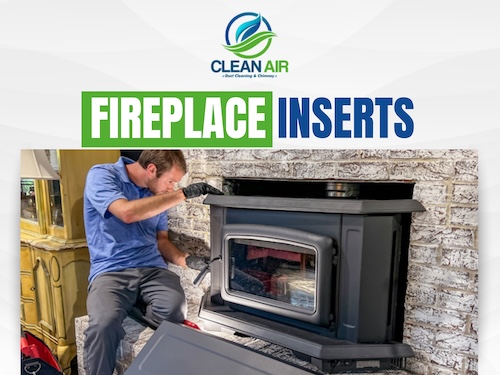
An existing fireplace does not always need to be rebuilt or replaced to change how you use it. In many cases, an insert can work within the existing fireplace opening while giving you a different fuel option, operating style, and finished look.
Clean Air Duct Cleaning & Chimney provides Fireplace Inserts in Atlanta for homeowners considering gas, wood, or electric inserts in an existing fireplace.
We look at the fireplace opening, chimney condition, venting requirements, clearances, and the type of insert you want before determining what the existing setup can support.
Need Help? Call Clean Air Duct Cleaning & Chimney Near You
A fireplace insert is installed within an existing fireplace opening rather than creating an entirely new fireplace location.
That makes inserts particularly relevant when you want to keep the existing fireplace structure but change how the fireplace operates.
An insert may be worth considering when you want:
The existing fireplace still matters.
An insert does not make chimney damage, deteriorated masonry, moisture problems, or an unsuitable vent path disappear. Those conditions need to be understood before installation.

The source page identifies three main fireplace insert options.
Gas inserts are suited to homeowners who want quick startup and controlled operation without storing or carrying firewood.
Depending on the unit, installation may involve a dedicated venting arrangement through the existing chimney along with the required gas connection.
If you already know gas is the direction you want to take, our gas fireplace installation service provides more specific information about gas setup and installation.
Wood inserts retain the experience of burning real logs while placing the fire within an insert installed in the existing fireplace.
They also place specific demands on the chimney and liner arrangement.
For homeowners specifically considering this option, wood fireplace inserts provides a more focused service path.
Electric inserts provide the fireplace appearance and supplemental heat without combustion exhaust.
They can be useful when the homeowner wants to reuse the fireplace opening but does not want to rely on gas, wood, or chimney venting.
The opening, electrical supply, surrounding materials, and finished fit still need to be considered.
Choosing an insert starts with more than measuring the width of the opening.
The existing fireplace needs to accommodate the insert itself, its required connections, and the finished surround.
We may need to consider:
A fireplace that looks large from the room may become much narrower farther inside.
That is why the usable dimensions matter more than the appearance of the opening alone.
An insert uses an existing fireplace as part of the project, so the condition of that fireplace matters.
Before planning installation, the source page recommends looking at areas such as:
Minor issues may be addressed before the insert goes in.
More substantial deterioration may change whether installation should move forward as originally planned.
If the existing fireplace needs work first, you may need to handle the repair separately.
Need Help? Call Us For Fireplace Inserts installation Services!
For combustion-based inserts, the chimney is more than the masonry surrounding the unit.
The exhaust still needs an appropriate route out of the home.
Depending on the insert and existing chimney, liner planning can involve:
The existing flue should not automatically be assumed suitable simply because the fireplace has been used before.
When the liner or flue configuration needs to change for the new setup, chimney relining may become a separate part of the project.
Installation is easier to plan when existing fireplace and chimney problems are handled first rather than covered by the new unit.
The source page identifies several conditions that may need attention beforehand, including:
The specific work depends on the type of insert.
An electric insert does not have the same venting requirements as a wood or gas insert, while a wood insert can place much greater importance on the existing chimney and liner.
This is why the insert type should be selected together with an evaluation of the existing setup.
An insert becomes part of the existing fireplace, so the finished appearance matters too.
The unit needs to sit correctly within the opening while the surrounding components create a finished transition between the insert and the existing fireplace.
Planning can include:
The objective is not simply to make the insert physically fit.
It should also make sense within the existing fireplace and remain practical to operate and service.
These projects can sound similar, but they are not always the same.
A fireplace insert uses the existing fireplace opening to house a new unit.
A fireplace conversion focuses on changing the existing fireplace from one fuel or operating setup to another.
A new fireplace installation may create an entirely new fireplace or install a unit in a location where no usable fireplace currently exists.
If the existing fireplace provides a suitable starting point, an insert may avoid unnecessary changes to the rest of the fireplace structure.
If the desired project extends far beyond the opening, another service may be more appropriate.
Atlanta homes include older masonry fireplaces, remodeled fireplaces, and systems that may not have been used regularly for years.
An older fireplace can still be a candidate for an insert, but age alone does not determine suitability.
Condition does.
Moisture, previous repairs, chimney deterioration, existing liner configuration, and available opening dimensions can all affect the project.
For Fireplace Inserts in Atlanta, we focus on whether the existing fireplace provides a workable foundation for the insert you are considering.
A fireplace insert project sits between the existing fireplace and the new appliance.
That means both sides of the project need to make sense together.
Our approach focuses on:
We also keep the scope clear.
If the fireplace only needs an insert, we keep the project focused there. If the chimney, liner, firebox, or another component requires separate work first, we identify that rather than treating the insert as a solution to an unrelated problem.
Recommendations are based on the existing fireplace and the insert being considered.
Clean Air Duct Cleaning & Chimney provides Fireplace Inserts in Atlanta for homeowners considering gas, wood, or electric options for an existing fireplace.
Tell us what type of fireplace you currently have, how you want to use it, and which insert option you are considering.
We can evaluate the existing opening and determine what fireplace, chimney, liner, or venting conditions need to be considered before installation.
Call (470) 706-6431 or contact us online to discuss your fireplace.
 Optimized by Seraphinite Accelerator