
 Skip to content
 Fireplace Refacing In Atlanta made easy with Clean Air Duct Cleaning and Chimney. Refresh brick and surrounds, boost safety and style. Get a free quote today
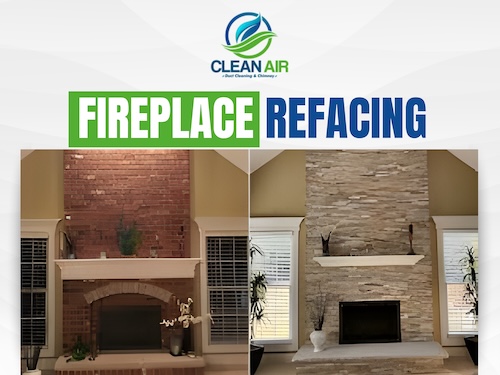
Your fireplace may still function well even when the brick, tile, stone, hearth, or mantel no longer fits the room.
Clean Air Duct Cleaning & Chimney provides Fireplace Refacing in Atlanta for homeowners who want to update the visible fireplace without unnecessarily rebuilding the entire system.
We look at the existing face, fireplace opening, hearth, surrounding materials, and how the fireplace is used before planning the new finish.
Need Help? Call Clean Air Duct Cleaning & Chimney Near You
Refacing focuses on the visible materials around the fireplace.
Depending on the existing setup and your project, that can include:
The firebox, chimney, and internal fireplace components are separate from the refacing itself.
That distinction matters.
When the existing fireplace is fundamentally usable and the main problem is appearance, refacing allows the project to stay focused on the part of the fireplace you actually want to change.

Refacing can be subtle or completely change the character of the fireplace.
Some homeowners want to remove a dated surface while keeping the existing proportions.
Others want to simplify a bulky fireplace face or create a stronger focal point in the room.
Possible changes include:
Old brick, tile, or another finished surface may be updated with a material better suited to the new design.
A worn, cracked, stained, or visually mismatched hearth may be incorporated into the refacing plan.
Mantel proportions can strongly affect how the fireplace looks.
Replacing an oversized or dated mantel can sometimes change the room as much as replacing the facing itself.
Refacing can also address visual issues such as uneven edges, awkward transitions, and finishes that no longer work with the surrounding wall.
Fireplace finishes need to work near heat, not simply look good on a sample board.
The existing page identifies several common refacing options.
Brick can maintain a traditional fireplace appearance or create a cleaner version of an existing masonry look.
It can work well when you want texture without dramatically changing the character of the room.
Stone adds more variation and depth.
Depending on the selected material and layout, it can work with traditional, transitional, or more contemporary fireplace designs.
Tile provides a broad range of shapes, finishes, and visual styles.
It is often useful when the goal is cleaner lines or a more defined fireplace surround.
Certain fireplace designs may use suitable noncombustible panel systems to create a flatter, simpler appearance around the opening.
The appropriate material depends on the fireplace setup and where the finished surface sits in relation to heat.
Not every part of the fireplace face experiences the same conditions.
Material selection needs to consider:
A finish suitable farther from the opening may not automatically be appropriate closer to the fire.
This is one reason we establish the existing fireplace configuration before finalizing the surface plan.
A new finish should not hide deterioration that needs separate attention.
Before refacing, we look for visible conditions that could affect the project, such as:
Black staining around the opening can also deserve closer attention because the appearance may be connected to how smoke has behaved rather than simply to an old finish.
When the issue extends into the fireplace itself, fireplace repair should be addressed separately before new facing covers the area.
These services overlap visually but solve different problems.
Refacing primarily changes the visible surface and design around a fireplace that provides a workable base for the project.
Fireplace restoration may involve preserving, repairing, or renewing more of the original fireplace rather than primarily changing its surface appearance.
Refacing makes more sense when you want a new finish.
Restoration may be more appropriate when retaining the existing fireplace character or repairing its original materials is part of the goal.
Need Help? Call Us For Fireplace Refacing Services!
The visible fireplace can also be updated when gas logs or an insert are already installed or being considered.
In those projects, the face should be planned around the actual fireplace configuration.
Details can include:
If you are planning a new fireplace insert, it often makes sense to establish the insert dimensions before finalizing the surrounding finish.
That prevents the refacing project from being designed around an opening that will soon change.
Once the existing fireplace and material direction are established, the project can move into the finish work.
Depending on the design, that may involve:
The exact amount of preparation depends on what is already on the fireplace.
A solid existing surface needing a straightforward update presents a different project from loose tile, deteriorated mortar, or an uneven face that needs correction first.
A fireplace naturally becomes one of the strongest visual elements in a living room.
That means changing it can affect the entire space without requiring a full room renovation.
Refacing can help when the existing fireplace:
The objective is not simply to put new material over old material.
The proportions, hearth, mantel, fireplace opening, and surrounding wall should look like they belong together.
Atlanta homes include older masonry fireplaces, remodeled living rooms, traditional brick surrounds, and fireplaces that have been modified by previous owners.
Some need only a visual update.
Others show staining or deterioration that should be understood before finish work begins.
For Fireplace Refacing in Atlanta, we start with what is already there and determine whether it provides a suitable base for the update you want.
When moisture appears to be affecting the fireplace face, the source should also be identified before installing new finishes. A chimney leaks evaluation may be appropriate when staining appears connected to water entry.
Fireplace refacing requires a different approach from ordinary wall finishing.
The new material has to work with the fireplace opening, heat exposure, hearth, mantel, and any existing fireplace components that will remain.
Our approach focuses on:
If the fireplace is suitable for refacing, we keep the work centered on the finish.
If another condition needs attention first, we explain that separately.
Recommendations are based on the existing fireplace and the result you want to achieve.
Clean Air Duct Cleaning & Chimney provides Fireplace Refacing in Atlanta for homeowners updating brick, stone, tile, hearths, mantels, and other visible fireplace surfaces.
Tell us what you want to change and whether the fireplace has any existing staining, loose materials, damage, or previous modifications.
We can evaluate the current face and help determine what needs to remain, what can change, and whether anything should be addressed before the new finish is installed.
Call (470) 706-6431 or contact us online to discuss your fireplace.
 Optimized by Seraphinite Accelerator