
 Skip to content
 Need Dryer Vent Installation In Atlanta? Clean Air Duct Cleaning & Chimney installs code compliant vents to boost safety, airflow and dryer efficiency. Call now today
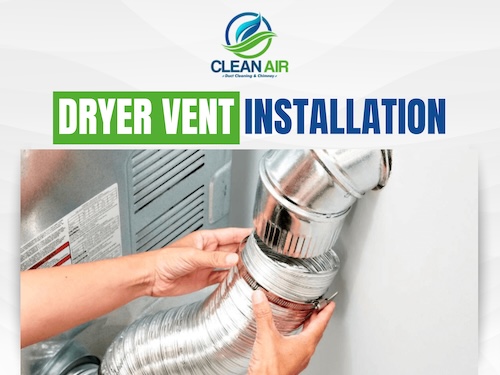
A dryer vent installation should create a direct exhaust path from the dryer to the outdoors. The route, material, number of turns, connection behind the appliance, and exterior termination all affect how well that system works.
Clean Air Duct Cleaning & Chimney provides Dryer Vent Installation in Atlanta for new laundry setups, remodeled spaces, damaged vent lines, and existing routes that need to be replaced or redesigned.
Need Help? Call Clean Air Duct Cleaning & Chimney Near You
The best vent path depends on where the dryer sits in relation to an exterior wall or other suitable termination point.
Before installation, we consider:
A shorter, more direct route is generally easier to maintain than one with unnecessary bends and long hidden sections.
When the laundry room has moved or the existing path no longer makes sense, dryer vent rerouting may be part of the installation plan.

A dryer produces heat, moisture, and lint during every cycle.
That exhaust needs a complete path to the exterior.
A dryer vent should not simply end inside:
The exterior termination also needs to be placed where exhaust can leave without immediately being blocked by surrounding materials or debris.
This is one of the most important differences between a complete dryer vent installation and simply attaching ductwork behind the appliance.
The vent material affects both airflow and how easily lint can collect.
The source page identifies several common options:
| Vent Material | Typical Use | Main Consideration |
|---|---|---|
| Rigid metal duct | Main vent runs | Smooth interior and holds its shape |
| Semi-rigid metal | Tight connection areas | Can kink when bent too sharply |
| Foil or plastic flex | Often found in older or quick installations | Can sag, tear, and collect lint more easily |
For the main run, rigid metal duct is generally preferred where the layout allows it.
Elbows, fittings, and transitions also need to fit the route without creating unnecessary restrictions.
A good vent route can still fail at the final connection if the dryer is pushed too tightly against the wall.
The space behind the appliance needs enough clearance for the transition connection to remain open rather than being:
This is especially important in compact laundry closets where every inch matters.
The installation should account for the appliance position before the final connection is made.
Dryer vent installation is easier to plan before walls, cabinets, and appliances lock the layout into place.
This matters during:
Planning early gives more options for creating a direct route and placing the exterior termination somewhere that will remain accessible.
Trying to add the vent after everything else is finished can create a longer or more complicated path than necessary.
Need Help? Call Us For Dryer Vent Installation Services!
Not every installation starts from scratch.
An existing vent may need replacement when it is:
In these cases, installation is about rebuilding the exhaust path rather than repairing one isolated section.
If the existing system only has localized damage, dryer vent repair may be enough instead.
The condition of the current route determines which approach makes more sense.
Some Atlanta homes place laundry rooms far from an exterior wall.
That can require the vent to travel:
These installations need careful routing because every additional turn affects the overall path.
We also consider how the line will be supported and how future dryer vent cleaning can be performed without opening finished surfaces.
The vent does not end when the duct reaches the exterior wall.
The termination needs a proper exterior hood or fitting that allows exhaust to leave while protecting the opening from outside conditions.
We consider:
A poorly placed exterior hood can create problems even when the interior duct route is good.
Atlanta properties include older homes, remodeled floor plans, townhomes, garages, interior laundry closets, and multi-story layouts.
The source page specifically identifies longer interior routes, townhome routing, older additions, crawl-space and attic access, and exterior termination placement as common planning factors.
For Dryer Vent Installation in Atlanta, the route has to fit the actual property rather than forcing the same layout into every home.
A dryer vent installation should make the complete exhaust path easier to understand, use, and maintain.
Our approach focuses on:
Recommendations are based on the existing layout and the route available in the home.
Clean Air Duct Cleaning & Chimney provides Dryer Vent Installation in Atlanta for new laundry areas, remodels, replacement vent lines, and homes where the existing route no longer works well.
We can review the dryer location, available route, vent material, exterior termination, and access before deciding how the new system should be installed.
 Optimized by Seraphinite Accelerator