1. Home
  2. »
  3. Commercial Dryer Vent Installation

Commercial Dryer Vent Installation in Atlanta, GA

Need Commercial Dryer Vent Installation In Atlanta done right? Clean Air Duct Cleaning & Chimney installs code ready vents for safer efficient laundry rooms. Call now
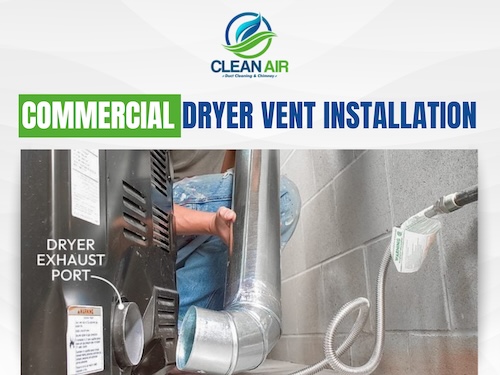
Table of Contents
Commercial Dryer Vent Installation In Atlanta Pros
Need Commercial Dryer Vent Installation In Atlanta done right? Clean Air Duct Cleaning & Chimney installs code ready vents for safer efficient laundry rooms. Call now

Commercial Dryer Vent Installation

Commercial dryer vent installation creates a safe, direct exhaust path for busy laundry rooms, and we handle the planning and full setup for Atlanta businesses.

Clean Air Duct Cleaning & Chimney provides commercial dryer vent installation in Atlanta that keeps airflow steady and moisture moving outside.

For commercial dryer vent installation in Atlanta, we focus on smart routing, solid materials, and clean connections that are easier to maintain.

Need Help? Call Clean Air Duct Cleaning & Chimney Near You

What commercial dryer vent installation covers

Commercial dryer vent installation covers the full exhaust path from the dryer outlet to the building exterior. A commercial dryer makes heat, moisture, and lint every day. The vent system has one job. Move that exhaust out of the building without leaks, backdrafting, or lint buildup in the wrong places.

Commercial venting is not the same as a quick residential hookup. Many commercial laundry rooms run longer hours, handle heavier loads, and produce more lint. That extra lint finds every sharp turn, sag, and loose joint. When the vent path needs ongoing care, ongoing commercial dryer vent maintenance becomes much easier when the installation is laid out with access in mind.

A simple facility question

If you manage a facility, ask yourself a simple question. Can someone trace the vent path and access it without moving machines or tearing out ceiling tiles. If the answer is no, a better route or access approach may be needed, and a dryer vent inspection can help confirm what is happening.

Why correct vent layout matters

A correct vent layout helps your dryers run closer to how they were meant to run. Good airflow supports steadier drying and a less miserable laundry room. Poor airflow often shows up as longer cycles, hotter rooms, and staff complaints that never quite go away.

A well installed vent also reduces how much lint ends up in ceiling spaces, wall cavities, and back of house areas. If lint issues have already started, pairing installation work with commercial dryer vent cleaning can help reset the full path.

Signs you may need a new vent installation

You may need a new vent installation when your current setup cannot exhaust safely or consistently. Dryers can look fine and still perform poorly if the vent is wrong. Many commercial spaces inherit vent runs that were patched over time. Tape, crushed flex, and extra elbows tend to pile up after remodels.

Watch for these common signs

  1. Dry times are getting longer across multiple loads.
  2. The laundry room feels hot or damp even with normal use.
  3. Lint is visible behind machines or on the floor near the vent connection.
  4. The vent pipe sags, rattles, or looks temporary.
  5. You see moisture stains near ceiling penetrations or exterior wall exits.
  6. The exterior vent hood looks blocked, damaged, or always half closed.
  7. Staff prop doors open to cool the room down.

Are you seeing two or three of these at the same time. That is usually a vent system issue, not a bad dryer problem. When symptoms overlap, a targeted commercial dryer vent repair or a full reroute may be the right next step.

Vent issues can become building issues

Vent issues can show up as building issues, not just laundry issues. Moist air that stays indoors can push humidity into adjacent areas. Over time, that can affect paint, drywall, and odors in nearby hallways or storage rooms.

If your laundry room shares space with mechanical equipment or storage, a poor vent path can also mean lint collecting where it should not. Nobody wants lint drifting onto clean linens. In some spaces, a camera inspection helps confirm where lint is accumulating inside hidden runs.

Common causes of commercial vent problems

Commercial vent problems often start with routing, materials, and terminations that do not match real use. Most vent failures are simple. The path is too long, too twisty, or built from the wrong duct type. Lint slows down at bends, catches on seams, and sticks in low spots.

Common causes we see around Atlanta GA

  • Long runs added after a remodel, with no plan for service access.
  • Too many elbows, especially tight turns right off the dryer outlet.
  • Thin flex duct used where rigid metal duct should be.
  • Duct sections not supported, leading to sagging and lint pooling.
  • Leaky joints that blow lint into ceilings or behind walls.
  • Terminations that face the wrong direction or get blocked easily.
  • Multiple dryers tied into venting that was not set up for that layout.

If the vent route looks like it was made to fit, it usually was. And lint always finds the weakest part first. When routes are long or complex, combining installation planning with duct leakage testing style thinking helps reduce hidden leaks into building cavities.

Termination choices matter

Termination choices matter more than most people think. The outside end of the vent is where exhaust leaves the building. If the termination is blocked, damaged, or poorly placed, the whole system struggles. If the exterior end is not functioning, dryer vent repair may be needed even when the interior run looks fine.

A good termination should open freely during dryer operation and close when the dryer is off. It should also be positioned where exhaust will not blow straight into foot traffic areas, loading zones, or fresh air intakes.

Our planning and installation process

Our visit starts by confirming how your laundry room works and what the building will allow. We begin with a walkthrough and a clear plan. We look at the dryers, their location, and the most direct route to the outside. We also look at what is around the route, since duct runs do not exist in a vacuum.

What we focus on first

  1. Dryer type, count, and location
  2. Existing vent path and where it exits the building
  3. Access points for maintenance and cleaning
  4. Clearances around equipment and ducting
  5. Nearby items that affect safety, like electrical lines or stored materials
  6. Where staff and carts move through the room

Do you need the laundry room to stay usable during certain hours. Tell us. We plan work that respects how your site runs, and we can coordinate around routine commercial HVAC cleaning or other building work when schedules overlap.

Need Help? Call Us For Air Duct Services!

Route selection and support planning

We confirm a vent route that is direct, supported, and realistic to maintain. A vent system that cannot be cleaned is a vent system that will clog. Commercial laundry rooms do not have the luxury of set it and forget it. If you want a cleaner baseline over time, regular dryer vent maintenance is easier when access points are part of the original plan.

We look for routes that reduce length and turns where possible. We also plan support points to prevent sagging and movement over time.

What a typical installation includes

We install venting that aims for code ready results and practical service access. Our goal is a vent system that exhausts properly and can be serviced without a circus act. That means clean joints, stable ducting, and a termination that works as it should.

Typical steps on site
  1. Removing or isolating any incorrect sections that are part of the new route
  2. Setting the route and marking support points
  3. Installing rigid metal duct where appropriate for strength and airflow
  4. Using proper connectors at transitions and at the dryer outlet
  5. Sealing joints and aligning the run to limit lint hang ups
  6. Installing or replacing the exterior termination
  7. Checking operation so airflow is moving out, not leaking into the space

We also point out anything that will create future trouble, like storage pressed against ducting or a connection that gets crushed whenever a dryer is pushed back. When needed, we may recommend follow up commercial dryer vent cleaning intervals based on how your room is used.

Worksite habits

We keep the work area orderly because laundry rooms are busy spaces. Commercial laundry rooms are often tight and active. We work cleanly, keep parts staged, and avoid turning your back room into a maze.

If you have tenants, guests, or staff moving nearby, we can coordinate entry points and work zones. Nobody wants to explain a duct pile to a confused resident at 7 a.m.

Installation options for commercial laundry rooms

Commercial dryer vent installation options depend on the dryer count, building layout, and vent distance. Some sites need a full new run. Others need a reroute that fixes the biggest airflow bottlenecks. We match the work to what your laundry room needs, not what looks good on paper.

Common installation and improvement options

  • New vent run from dryer location to an exterior wall exit
  • New vent run to a roof termination when wall exits are not practical
  • Rerouting to reduce length and elbow count
  • Replacing crushed, sagging, or wrong duct sections
  • Adding stable supports so ducting stays aligned
  • Replacing an exterior termination that blocks or fails to open
  • Creating access points that make future cleaning more practical

Have multiple dryers in one room. We can review layout and talk through vent routing choices that keep service access workable, and we can coordinate with commercial dryer vent installation needs across larger facilities.

Quick material guide

A quick material guide helps explain why some vents clog faster than others. Not all duct materials behave the same after months of lint exposure. Smooth, rigid metal tends to move air better and collect less lint than thin flex options.

Simple comparison

Vent typeWhere it fits bestWhat tends to go wrong
Rigid metal ductMain vent runs through walls, ceilings, chasesPoor support can still cause noise or misalignment
Semi rigid metalShort connections where space is tightCan kink if pushed back too far
Thin foil or plastic flexBest avoided for commercial exhaustCrushes, tears, traps lint, shortens airflow path fast

If your current vent looks like a slinky doing yoga behind the dryer, it is usually time for a better setup. If airflow is already restricted, a dryer vent cleaning can help remove accumulated lint before or after the upgrade.

Timing and access factors

Installation time depends on access, vent distance, and how much of the route is exposed. Many commercial installs can be completed in a single visit, but the building layout decides the pace. A straight wall exit is usually simpler than a long ceiling run across multiple spaces.

Factors that affect the schedule

  1. Long runs that require more supports and careful alignment
  2. Limited access above ceilings or behind finished walls
  3. Roof access rules and safe work setup
  4. Multiple dryers that need coordinated vent routing
  5. Removing old vent sections that are stuck, hidden, or unsafe
  6. Working around business hours and building traffic patterns

If your laundry room is in a mixed use property, the route may pass through areas that need coordination. We will explain the plan before we start, and we can include a dryer vent inspection step when the route is partially concealed.

Safety guidance for commercial dryer vents

Safety matters because dryer exhaust combines heat, lint, and confined spaces. A dryer vent is not just a pipe. It is a hot exhaust route carrying flammable lint. A bad vent setup can raise fire risk and can also push humid air back into the room.

For general fire safety context, see guidance from the U.S. Fire Administration on clothes dryer fire prevention.

Stop using the dryer and call for help if you notice

  1. A burning smell during operation
  2. The dryer shuts off unexpectedly from overheating
  3. The laundry room gets unusually hot fast
  4. The vent pipe is disconnected or leaking lint
  5. The exterior termination is blocked and not opening

If staff say the dryer is fine but the room feels like a sauna, believe them. That is often a venting issue trying to get your attention. In these cases, commercial dryer vent repair may be the safest next move.

Clean Air Duct Cleaning & Chimney

Backdrafting and moisture in the room

Do not ignore backdrafting or moisture in the room. Exhaust should move out of the building. If warm damp air is blowing back into the space, the vent path may be restricted, leaking, or ending in the wrong place.

Moisture problems also feed odors. If your laundry area smells musty even after cleaning, poor venting may be part of the story. If humidity is affecting adjacent spaces, services like sanitization and disinfection can be useful after the venting is corrected.

How to prepare for installation and keep it working

You can prepare for your installation by clearing space and sharing a few key details. A little prep saves time and keeps the work area safer. It also helps us keep your operations moving.

Before we arrive it helps to

  1. Clear a path to the dryers and the likely vent route.
  2. Move carts, boxes, and stored linens away from the work zone.
  3. Share dryer count and basic type so we plan connections correctly.
  4. Point out any prior clogs, leaks, or recurring overheating issues.
  5. Identify who can approve routing decisions on site.
  6. Let us know your preferred work window if laundry demand has peaks.

Do you have a utility chase access panel or roof hatch key that only one person carries. Tracking that down early makes the day easier. If your site has recurring lint buildup, plan ahead for follow up commercial dryer vent maintenance so the new route stays clear.

After installation routines

After installation, simple routines help keep airflow steady and lint under control. A good vent install sets the foundation, but daily habits keep it working. Commercial laundry rooms create lint nonstop. If lint management slips, vents load up faster.

Early warning signs
  1. Dry times start creeping up again.
  2. You notice new vibration or rattling from duct sections.
  3. Lint appears around joints or on nearby surfaces.
  4. The termination flap does not open fully during operation.
  5. The room starts getting warmer than normal.

Helpful routines for staff

  1. Clean lint screens on the schedule you use for each cycle or shift.
  2. Keep the space behind dryers clear so vent connections do not get crushed.
  3. Avoid storing supplies against ducting or termination access points.
  4. Log changes in dry time so problems get noticed early.
  5. Keep the exterior termination area clear of debris and obstruction.

If your maintenance team keeps a site binder, add a note showing the vent route and termination location. Future troubleshooting gets faster, and scheduling periodic dryer vent inspections is simpler when everyone knows the access points.

Atlanta specific venting challenges

Atlanta, Georgia properties often create venting challenges that need careful routing. Buildings in Atlanta range from older masonry structures to newer mixed use properties. Many laundry rooms get placed wherever space was available, not where venting is easiest.

Common local scenarios

  • Laundry rooms far from outside walls, creating longer runs
  • Shared back of house spaces with tight clearances and competing equipment
  • Renovated areas where old vent routes were abandoned or patched
  • Roof termination needs on multi story buildings with restricted access
  • Tight corridors where carts and staff movement can bump venting

We plan the route that fits the building you actually have, not the floor plan someone printed ten years ago. When long routes are unavoidable, we can discuss options like dryer vent booster fan installation based on site conditions.

Why businesses choose our team

Businesses choose Clean Air Duct Cleaning & Chimney because we keep the process clear and the work practical. You need the vent installed correctly, but you also need it to make sense for daily operations. We focus on straightforward communication, neat work habits, and vent paths that can be cleaned without drama.

What you can expect

  1. A walkthrough that focuses on airflow, safety, and access
  2. A vent route that reduces avoidable turns and sag points
  3. Solid connections that stay put after the dryers get pushed back
  4. A termination setup that exhausts outside the way it should
  5. Respect for your staff workflow and the space around the laundry room

If you have dealt with repeat lint issues, we will look at the full path, not just the last few feet near the machine. In many buildings, improving the laundry exhaust also complements broader airflow goals tied to commercial air duct cleaning.

Commercial dryer vent installation in Atlanta

Commercial dryer vent installation in Atlanta starts with a site check and a plan that fits your building. If your dryers run hot, take too long, or your venting looks patched together, it is time to fix the root cause. Clean Air Duct Cleaning & Chimney handles commercial dryer vent installation for busy laundry rooms across Atlanta and GA, with routing and materials chosen for real commercial use.

To review your setup, call (470) 706-6431 and ask about options like commercial dryer vent installation and ongoing commercial dryer vent cleaning support.

Related Services

For commercial dryer vent installation in Atlanta GA, call (470) 706-6431 or use the Contact Us page to schedule a visit.

Frequently Asked Questions (FAQs)

It’s the setup of vent piping and related components that route dryer exhaust safely from a commercial dryer to an exterior termination point.
Yes. Clean Air Duct Cleaning & Chimney offers commercial dryer vent installation services for businesses.
Proper installation helps support safe exhaust flow, reduces lint buildup risk, and can help the equipment operate as intended under regular use.
Common examples include laundromats, hotels, gyms, salons, healthcare facilities, and multi-family properties with shared laundry rooms.
Sometimes, but it depends on the vent’s condition, layout, and compatibility with the dryer and local requirements; an on-site review is usually needed.
Key factors include dryer type, distance to the exterior, number of turns, available access for maintenance, building layout, and applicable codes.
Installations commonly use rigid metal ducting and appropriate connectors and terminations, selected based on the application and local requirements.
Yes. Commercial dryer venting is generally expected to follow applicable building codes and the dryer manufacturer’s installation guidelines.
Signs can include frequent lint accumulation, excessive heat in the laundry area, longer drying times, unusual odors, or visible damage to vent components.
Typically, the provider reviews the site conditions, confirms the vent route and termination location, installs or updates vent components, and verifies basic airflow and connections; Clean Air Duct Cleaning & Chimney can discuss options based on your space.
Why Your Home Airflow Drops When Dust Builds Up in Ducts

Why Your Home Airflow Drops When Dust Builds Up in Ducts

Your home airflow drops when dust builds up in ducts because that dust acts like…

Why Regular Chimney Sweeping Helps Keep Your Fireplace Safe

Why Regular Chimney Sweeping Helps Keep Your Fireplace Safe

A clean chimney lets smoke move out of your home, not back into your face.…

Signs Your Air Ducts Need Cleaning Before the Seasons Change in Atlanta, GA

Signs Your Air Ducts Need Cleaning Before the Seasons Change in Atlanta, GA

Your air ducts may need cleaning before a seasonal change if you notice more dust,…

How Creosote Forms and Why It Needs Removal

How Creosote Forms and Why It Needs Removal

Creosote forms when wood smoke cools inside your chimney and turns into a sticky, dark…

Dryer Vent Lint Buildup and Fire Risk, What Every Atlanta Homeowner Should Know

Dryer Vent Lint Buildup and Fire Risk, What Every Atlanta Homeowner Should Know

Lint buildup in a dryer vent raises fire risk because it blocks airflow. When hot…

Why Annual Chimney Inspections Protect Your Fireplace and Home

Why Annual Chimney Inspections Protect Your Fireplace and Home

An annual chimney inspection helps you catch hidden trouble before it grows. A pro can…