Skip to content

If your chimney smells bad even when you haven’t used the fireplace in months, you’re not alone. A bad chimney smell is one of the most common complaints we hear from Atlanta homeowners, especially on hot, humid summer afternoons, after heavy rain, or whenever the air conditioning is running.
But here’s what many homeowners don’t realize: a bad chimney smell doesn’t always mean your chimney is dirty. Sometimes the cause is creosote buildup. Other times it’s rainwater coming through a cracked chimney crown, nesting material decomposing above the damper, or negative air pressure pulling stale chimney air into your living room.
At Clean Air Duct Cleaning & Chimney, we’ve traced chimney smell problems like these in fireplaces across Atlanta, Sandy Springs, Roswell, Marietta, Alpharetta, Dunwoody, Brookhaven, Decatur, and Smyrna. One memorable service call in Midtown Atlanta involved a homeowner dealing with an unbearable, sour, decaying odor every afternoon. Our technician, Trell, found that the problem wasn’t just soot — nesting debris, rainwater, and negative air pressure were all contributing.
In this guide, we’ll explain the seven most common causes of a chimney smell, what different odors may indicate, how to get rid of the smell for good, when a smell is potentially dangerous, and what Atlanta homeowners can expect to pay in 2026.
Table of Contents
- Why Does My Chimney Smell Bad? The Quick Answer
- 7 Common Causes of a Bad Chimney Smell
- A Real Example: Trell’s Midtown Atlanta Chimney Smell Investigation
- Why Chimney Smells Are Worse During Atlanta Summers
- What a Proper Chimney Smell Inspection Includes
- How to Get Rid of a Bad Chimney Smell for Good
- How Much Does It Cost to Remove a Chimney Smell in Atlanta in 2026?
- Why Does My Chimney Smell After Cleaning? What Cleaning Won’t Fix
- DIY Fixes That Don’t Solve a Chimney Smell
- When Is a Bad Chimney Smell Dangerous?
- How to Prevent a Chimney Smell in Atlanta
- How to Choose the Right Chimney Company
- Final Answer
- Final Advice From Our Team
- FAQ
Why Does My Chimney Smell Bad? The Quick Answer
Most chimney smell problems come from one or more of these seven issues:
- Creosote and soot buildup — smoky, burnt-barbecue, or tar-like odors.
- Water intrusion and moisture — damp, musty, or sour smells.
- Birds, squirrels, or other wildlife — animal waste or decomposing odors.
- Leaves and rotting organic debris — earthy, stagnant, or compost-like smells.
- Negative air pressure and downdrafts — odors pulled into the home, often when exhaust fans or HVAC equipment run.
- Damaged liners or combustion-venting problems — smoke or unusual combustion odors that may point to an unsafe system.
- Missing or damaged chimney caps — rain, wildlife, and debris repeatedly entering the flue.
In Atlanta, three conditions often intensify these problems: high summer humidity, heavy rainfall, and changes in household air pressure. The smell is a clue, but it isn’t enough to diagnose the problem by itself.
What Does Your Chimney Smell Like? A Homeowner’s Identification Guide
Before scheduling service, pay attention to the odor itself and when it shows up.
| What You Smell | Possible Cause | When It Often Gets Worse |
|---|---|---|
| Smoky, campfire, or burnt barbecue | Soot and creosote | Hot, humid afternoons |
| Damp basement or mildew | Moisture intrusion or damp materials | After rain |
| Rotten garbage or decaying animal | Wildlife, nesting material, organic debris | Warm weather |
| Earthy, compost-like odor | Wet leaves or plant debris | After rain or extended vacancy |
| Stale chimney odor whenever fans run | Negative air pressure or downdraft | Kitchen exhaust, bathroom fans, certain HVAC conditions |
| Fresh smoke or combustion fumes | Draft failure, blockage, or appliance problem | During fireplace or appliance operation |
| Rotten eggs or sulfur | Possible natural gas leak | At any time — treat as urgent |
Important safety warning: if you suspect a natural gas leak, leave the building immediately. Don’t operate light switches, appliances, or anything that could create a spark. From a safe location, call 911 or your gas utility. Atlanta Gas Light provides guidance on its gas safety page. Also remember that carbon monoxide is odorless — you can’t use your sense of smell to tell whether CO is present.
7 Common Causes of a Bad Chimney Smell
Here’s what each cause looks like in a real Atlanta home, and what actually fixes it.
1. Creosote and Soot Buildup: Why Your Chimney Smells Like a Campfire
One of the most common complaints we hear is: “My fireplace smells like someone was burning wood yesterday, but we haven’t used it since winter.” It’s especially common in Atlanta’s summer months.
When wood burns, smoke carries particles, gases, and unburned compounds into the chimney, and some of that material builds up on the flue walls as soot and creosote. Over time, those deposits can create a smoky, tar-like, or burnt-barbecue odor, and heat and moisture make it more noticeable. If air is moving down the chimney instead of up, the smell travels into the living room. CSIA specifically identifies creosote deposits, summer humidity, and house-pressure problems as contributors to persistent chimney smells.
Signs creosote may be the problem: your fireplace smells smoky even when it’s cold, the odor gets noticeably stronger in July or August, you see dark soot around the damper or firebox, the chimney hasn’t been swept recently, or the smell returns when kitchen or bathroom fans run.
How to get rid of it: start with a professional inspection to see how much buildup there is and what type. A chimney sweep can remove accessible soot and creosote with the right brushes, rods, and vacuums, and heavier glazed deposits may need specialized removal — our guide to chimney soot removal covers the difference. Cleaning doesn’t guarantee every odor disappears, though: some residue stays in porous masonry, and downdrafts can keep carrying odors indoors. If your chimney smell returns every summer, don’t just buy deodorizing products. Find out how much buildup is present and whether air is being pulled down the flue.
2. Water Intrusion and Moisture: Why Your Chimney Smells Musty After Rain
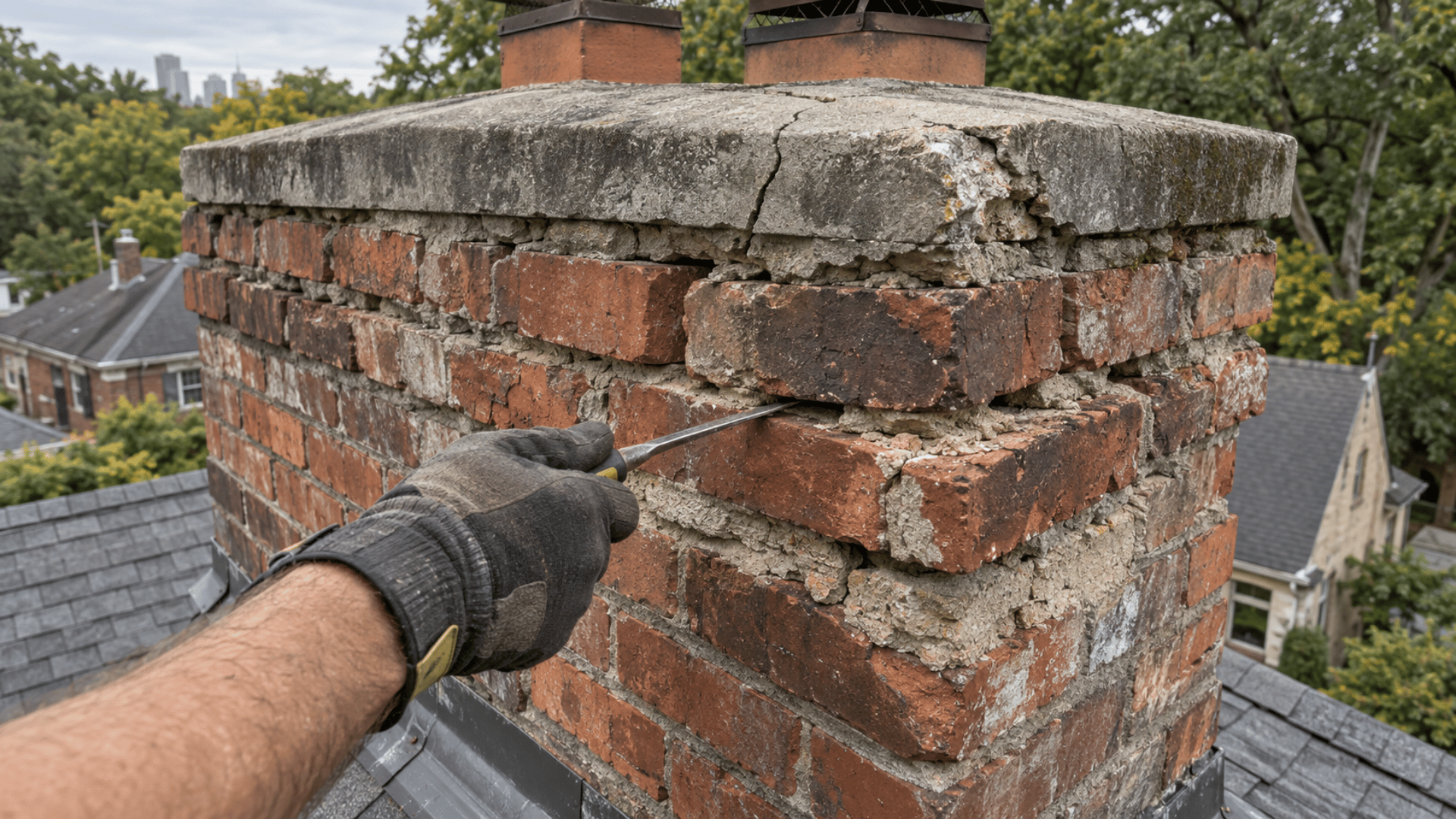
Atlanta gets substantial rainfall throughout the year, and chimneys are exposed to all of it. Water can enter through cracked concrete crowns, failed roof flashing, deteriorated masonry joints, missing caps, damaged chase covers, or other openings. When moisture reaches soot, ash, or debris inside the chimney, it can intensify existing odors, and repeated moisture can create conditions favorable to microbial growth on affected materials.
Homeowners usually describe a musty chimney smell as a damp basement, wet ashes, old musty wood, sour or stagnant air, or a fireplace that never seems to dry out. The most important clue is timing: if the fireplace smells worse during or right after rain, investigate moisture intrusion.
Signs your chimney may be leaking: rust on the damper, water stains near the fireplace, white powdery deposits on masonry, crumbling mortar joints, water dripping into the firebox, damp debris around the smoke shelf, or peeling paint and stained ceilings near the chimney.
How to fix it: the right repair depends on where the water is entering. A missing cap needs a cap, a cracked crown may need sealing or reconstruction, failed flashing needs repair or replacement, damaged mortar joints may need tuckpointing, and sound but highly absorbent masonry may benefit from a vapor-permeable water repellent. Waterproofing alone won’t repair an open crown crack, missing mortar, or failed flashing. Related reading: Does Your Chimney Need Waterproofing? 7 Warning Signs and Why Is My Chimney Leaking Water Inside?
3. Birds, Squirrels, and Other Wildlife Inside the Chimney
Atlanta’s mature tree canopy provides habitat for a lot of wildlife, and an uncapped or poorly protected chimney can look like an attractive place to shelter or nest. The resulting chimney smell can come from droppings, urine, old nesting materials, insects, moisture-soaked organic debris, or a trapped or deceased animal.
An animal-related smell is usually more pungent than ordinary creosote — homeowners often describe it as “something died in my fireplace.” Other warning signs include scratching or chirping, twigs falling into the firebox, feathers near the damper, flies around the fireplace, or a sudden rotten odor in warm weather.
What to do: don’t light a fire to drive animals out or burn away a nest — a nest can obstruct the flue and create a serious smoke or fire hazard. Arrange an inspection to find out what’s actually there. Wildlife has to be handled according to the species, nesting status, and applicable laws; in particular, chimney swifts are protected migratory birds, and active nests, eggs, and birds can’t be disturbed or removed unlawfully (the U.S. Fish & Wildlife Service publishes information on these protections). Once lawful removal and cleanup are appropriate, a technician may recommend clearing debris, cleaning contaminated areas, and installing a suitable cap to reduce future entry.
Removing the nest won’t necessarily eliminate the smell. If droppings or other waste remain around the smoke shelf, damper, or masonry joints, additional cleaning or sanitation may be needed.
4. Decomposing Leaves and Organic Debris
Not every rotten fireplace smell comes from a dead animal. Atlanta has plenty of oaks, pines, and other mature trees, and when a chimney has no cap — or the protective mesh is damaged — wind can carry leaves, twigs, and other debris into the flue. That debris collects around the smoke shelf or damper, and with moisture and warm temperatures, decomposition can produce a foul chimney smell.
Common signs: an earthy or sour odor, a smell that appears after rain, leaves or twigs visible in the firebox, a chimney that’s been unused for months, or a previous cleaning that didn’t address the smoke shelf.
The solution: a technician can inspect the flue and accessible smoke chamber areas to see whether debris has built up, then remove it. If contaminated organic material has left residual odors, additional sanitation may be recommended, and installing or repairing a suitable cap reduces the chance of a repeat.
5. Negative Air Pressure: Why Your Fireplace Smells When the AC Is Running
This is one of the most misunderstood causes. Homeowners often tell us: “My fireplace is fine until I turn on the air conditioning. Then the whole room smells like soot.” The chimney may not have developed a new problem when the AC came on — the pressure conditions inside the home may have changed.
A chimney is part of your home’s ventilation system. Under the right conditions, combustion products travel up and out. But when pressure inside the home is lower than outside, air can come in through the chimney instead, carrying residual soot and creosote odors into your living space — which is why the chimney smell seems to come and go. Common contributing factors include powerful kitchen range hoods, bathroom exhaust fans, clothes dryers, whole-house exhaust systems, poorly balanced HVAC ductwork, return-duct leakage, tight building envelopes, and certain seasonal stack-effect conditions. Air conditioning itself doesn’t automatically create negative pressure — duct leakage, airflow imbalance, and exhaust equipment are the usual culprits.
A simple clue: if the smell consistently shows up when exhaust equipment runs and fades when it stops, pressure-related airflow deserves a closer look. In a non-emergency situation, a technician may check whether briefly opening a window changes the odor or draft. That’s a useful clue, but it doesn’t prove the source or establish that the chimney is safe.
How to correct it: solutions may include correcting HVAC supply and return imbalances, repairing duct leakage, providing appropriately designed makeup air, evaluating exhaust equipment, addressing chimney draft problems, or considering a suitable top-sealing damper for a compatible fireplace. An energy recovery ventilator or makeup-air system can help in certain homes, but it has to be designed for the actual pressure problem.
Can a top-sealing damper stop chimney smells? For some wood-burning fireplaces, an approved top-sealing damper can close tighter than a conventional throat damper and reduce unwanted airflow when the fireplace isn’t in use. But it must be opened before lighting a fire, it isn’t suitable for chimneys that need to stay open for continuously vented gas or other fuel-burning appliances, it won’t remove creosote or contamination already inside the system, and it won’t automatically fix a house-wide pressure imbalance. Our guide to chimney damper repair and replacement covers when that upgrade makes sense. If your smell only appears when fans or HVAC equipment run, don’t assume another cleaning is the answer — have the airflow problem evaluated.
6. Damaged Chimney Liners or Improper Combustion Venting
Not every chimney smell is a routine cleaning problem. Some unusual smoke or combustion odors are associated with blocked flues, collapsed liner components, damaged flue tiles, improper appliance connections, inadequate draft, or combustion products entering the living space. A damaged liner doesn’t necessarily have its own distinctive smell — the concern is whether the chimney can safely contain and vent combustion products.
Warning signs: smoke entering the room, recurring soot deposits where they don’t belong, strong combustion odors during appliance use, unusual heat near adjacent structures, evidence of a past chimney fire, or a damaged or obstructed flue identified during an inspection.
What to do: stop using the affected fireplace or appliance and have the system professionally evaluated. If concealed or internal defects are suspected, a Level 2 inspection with video evaluation may be appropriate (see Chimney Inspection Levels Explained). Some localized defects can be repaired with an approved system, while other conditions need relining or more extensive work — our guide to chimney liner damage covers how that decision gets made. Don’t assume a chimney needs a $5,000 liner based on an odor alone. The recommendation should be backed by inspection evidence.
7. Missing or Damaged Chimney Caps
The chimney cap is one of the simplest yet most important parts for preventing a future chimney smell. A properly selected and installed cap helps reduce direct rain entry, wildlife intrusion, nesting opportunities, leaves and twigs entering the flue, and certain wind-related problems. When it’s missing or damaged, the chimney is far more exposed to the outdoor environment.
Signs the cap may be the problem: you can see the flue opening uncovered from the ground, water enters the fireplace during storms, birds or squirrels keep getting in, debris appears below the damper, the mesh is broken or missing, or the cap is loose, bent, or badly corroded.
Some prefabricated, factory-built systems have a metal chase cover as well as a flue termination cap — they’re different components. A damaged chase cover can let water into the chase even if the flue cap is intact, and the correct repair has to match the chimney system and manufacturer requirements. See our guide to chimney cap replacement cost in Atlanta for pricing and options.
A Real Example: Trell’s Midtown Atlanta Chimney Smell Investigation
A homeowner in Midtown Atlanta contacted us because an unbearable odor was taking over the living room. They described it as a combination of rotting organic material, sour moisture, and a heavy, stale fireplace smell. It was especially noticeable in the summer — every afternoon, when the central air conditioning was running, the smell seemed to get stronger. The homeowner couldn’t understand how a fireplace they hadn’t used recently could produce such a strong chimney smell.
What Our Technician Discovered
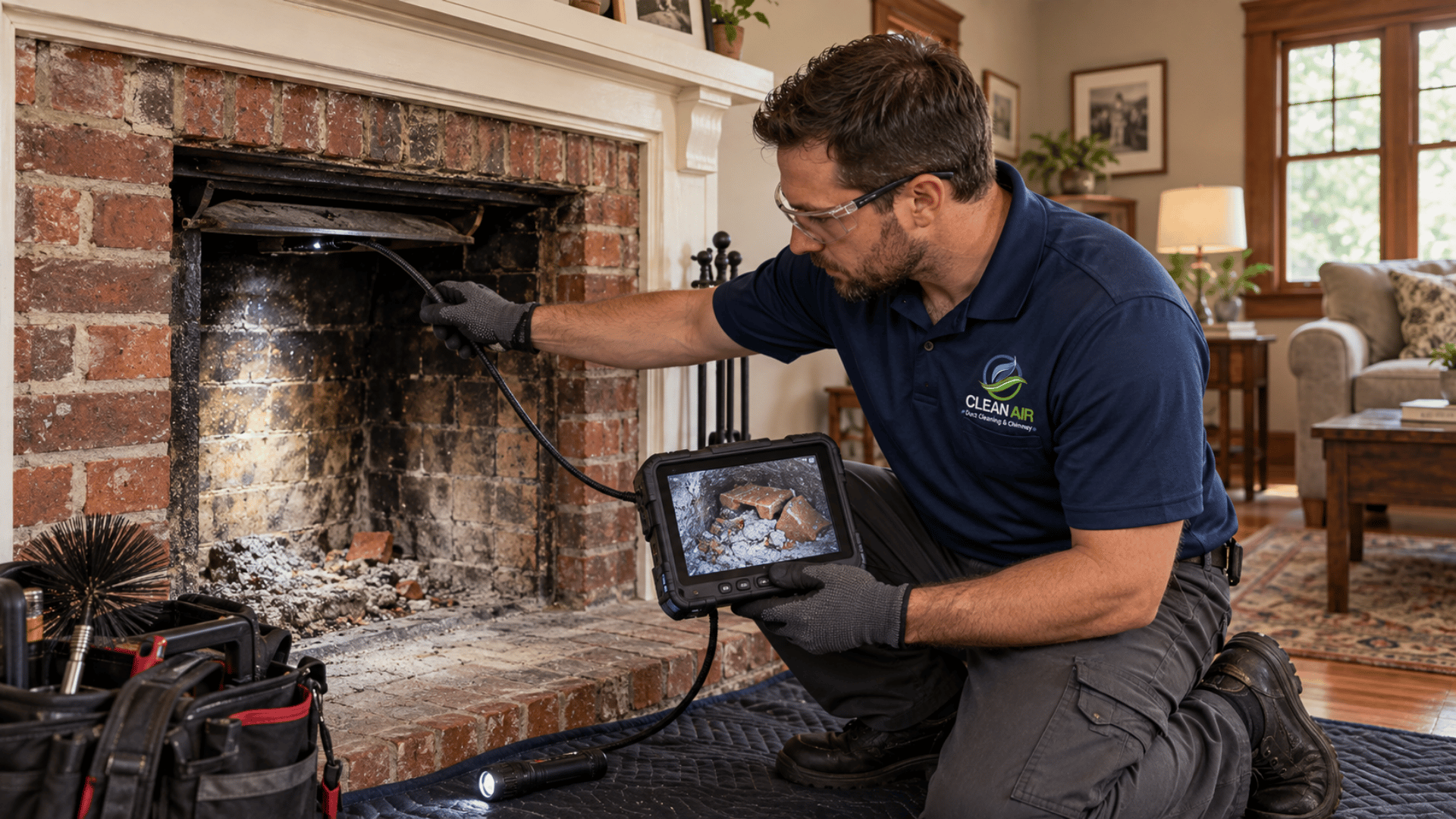
Our technician, Trell, inspected the fireplace and used a specialized chimney camera to examine the flue. The inspection revealed three contributing problems:
- Nesting debris above the damper. A bird had entered the uncapped chimney and established a nesting area, and organic debris and accumulated contamination were feeding the foul odor.
- Moisture-soaked soot and creosote. The chimney lacked adequate protection at the top, so rainwater had been entering the flue and interacting with existing soot, creosote, and organic material.
- Negative air pressure. The timing of the odor pointed to an airflow issue. When the home’s cooling system ran, conditions inside the house could encourage air to travel down through the chimney, bringing the existing odor into the living room.
That’s why simply spraying air freshener around the fireplace would never have solved it.
How the Problem Was Addressed
The response focused on removing the odor sources and reducing the conditions that let them develop. The team removed nesting debris and contamination, performed chimney cleaning and sanitation, and installed a properly fitted stainless steel chimney cap once the flue was clear and suitable for installation. (Any active protected wildlife has to be handled under the applicable rules before removal or exclusion work.) The cap helped reduce future rain and wildlife entry, and the cleaning and sanitation addressed the contaminated material inside the chimney. The homeowner reported relief from the persistent odor after the work.
The lesson for Atlanta homeowners: a bad chimney smell can have several causes at the same time. In this Midtown case, the problem wasn’t simply a dirty chimney — it involved debris, moisture, and airflow. That’s why a professional diagnosis can be more valuable than ordering a sweep without first understanding the problem.
Why Chimney Smells Are Worse During Atlanta Summers
Atlanta’s climate creates several conditions that can make a chimney smell more noticeable.
- Heat intensifies existing odors. Warm temperatures can increase the release of odor-producing compounds from accumulated residue or decaying material, so a fireplace that seems fine in January can smell unpleasant in July.
- Humidity affects soot and masonry. Humid air and damp chimney surfaces can intensify stale smoke and musty odors, and moisture entering through masonry defects makes it worse.
- Summer airflow can reverse chimney draft. In some homes, pressure differences favor air moving down an unused chimney, and exhaust fans and HVAC imbalances can make that worse.
- Wildlife and organic debris contribute. Warm weather intensifies decomposition odors when nesting material, waste, or leaves stay trapped.
The takeaway: you can have a clean-looking fireplace and still have a serious chimney smell problem if moisture, contaminated material, or pressure conditions are left unaddressed.
What a Proper Chimney Smell Inspection Includes
When homeowners contact us about recurring chimney smells, we focus on finding the source rather than recommending the same service for every home. Our diagnostic approach has five steps.
1. Understand the Odor and Its Timing
We ask what the smell resembles, when it began, whether it’s worse after rain, whether it happens when the AC is running, whether it occurs even when the fireplace is unused, whether the chimney was swept recently, and whether anyone has noticed animals or insects. The answers narrow down where to look.
2. Examine the Firebox, Damper, and Smoke Chamber
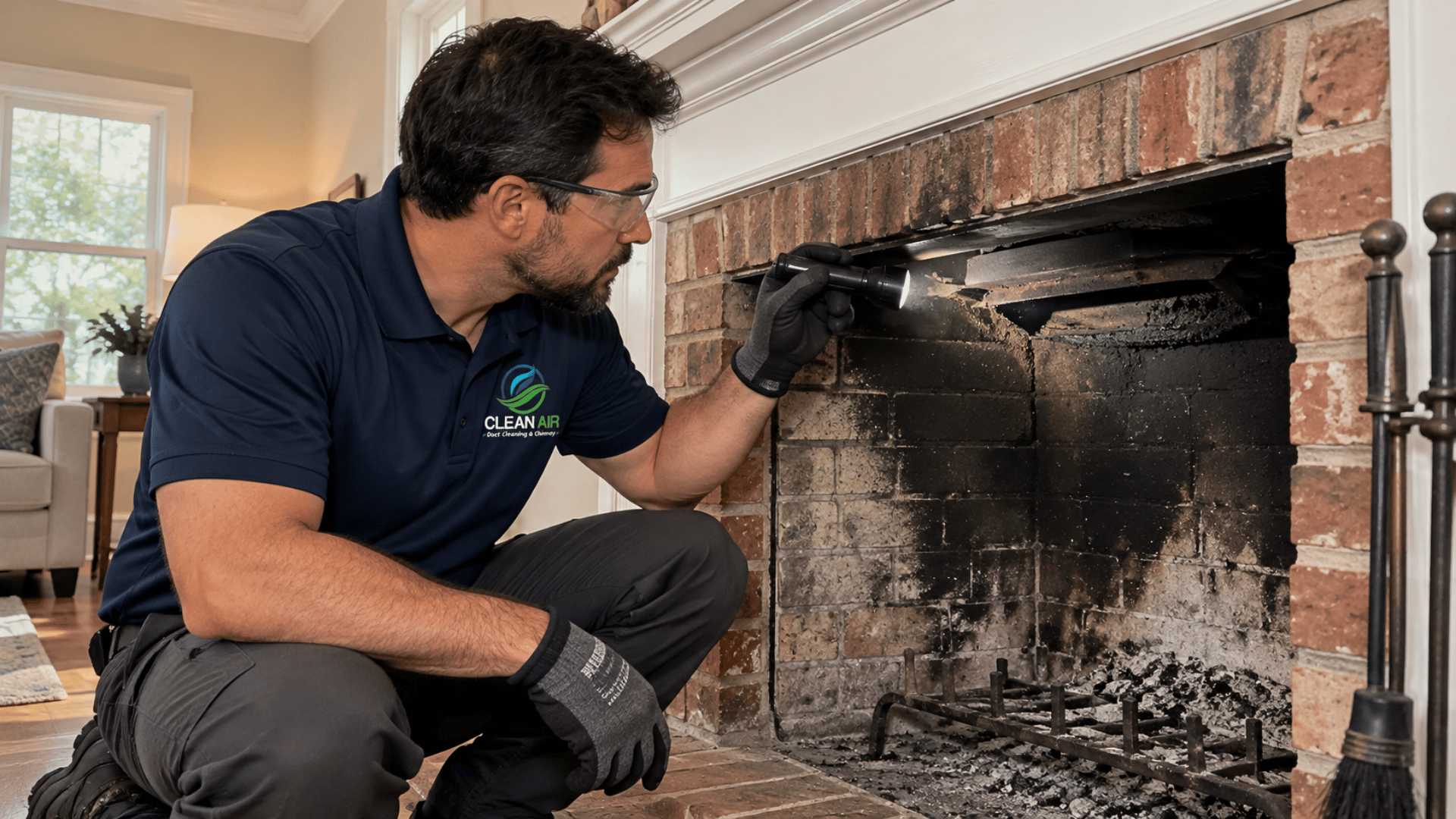
We inspect accessible areas for soot and ash, damper corrosion, debris, animal waste, moisture staining, and organic material on the smoke shelf. The smoke shelf matters most, because debris can sit there even when the visible firebox looks clean.
3. Use an Internal Camera Inspection When Appropriate
For hidden or persistent problems, chimney inspection cameras let us examine accessible flue sections for creosote deposits, nesting materials, water staining, obstructions, cracked liner sections, and deterioration you can’t see from the firebox. Footage documents physical conditions, though it can’t by itself measure every moisture or airflow problem — and not every odor needs the same inspection level. The scope should match the symptoms and the condition of the system. (For the difference between a cleaning and a diagnostic visit, see Chimney Cleaning vs. Chimney Inspection: What’s the Difference?)
4. Evaluate the Exterior Components
When safe access is available, we check the chimney cap, concrete crown, brick and mortar, flashing, chase cover, and other visible water-entry points to see whether rainwater is contributing to the chimney smell.
5. Evaluate Draft and Household Pressure
If the odor is tied to exhaust fans or HVAC operation, we look at possible downdrafts and pressure differences, and where needed, a further building-pressure or HVAC assessment helps pinpoint the cause. The goal is to separate an odor source inside the chimney from the airflow mechanism bringing it into the home.
How to Get Rid of a Bad Chimney Smell for Good
The best fix depends on the actual problem. Here’s how inspection findings usually map to solutions:
| Inspection Finding | Potential Solution |
|---|---|
| Significant accessible soot or creosote | Professional chimney sweeping or specialized creosote removal |
| Animal waste or organic contamination | Appropriate removal, cleaning, and sanitation |
| Wildlife entry or missing cap | Wildlife assessment and suitable cap installation |
| Moisture entering through crown, flashing, or masonry | Repair the actual water-entry point |
| Downdraft linked to pressure imbalances | Draft and ventilation assessment, followed by targeted correction |
| Damaged liner or blocked vent | Appropriate repair or relining based on documented condition |
- Professional chimney sweeping is best for soot, loose creosote, and accessible combustion residue — it removes the accumulated material behind smoky odors.
- Chimney sanitation is best for certain organic contamination and residual odors after debris removal. An appropriately selected sanitation or odor-control treatment may help, but it has to be compatible with the chimney materials and used according to the manufacturer’s instructions. Not every odor responds to an enzymatic product, and a spray is not a substitute for removing contaminated material. Learn more about our chimney sanitation service in Atlanta.
- Chimney cap installation is best for reducing future rain, animal, and debris entry. A stainless steel cap is often a worthwhile preventive upgrade when it’s compatible with the flue.
- Crown, flashing, or masonry repairs are best for water-related smells caused by real defects. Repair the damaged component first, then consider additional moisture protection where appropriate.
- Draft and ventilation corrections are best for a recurring odor pulled into the house by negative pressure.
- Damper upgrades are best for some wood-burning fireplaces with unwanted air exchange when unused. A top-sealing damper may help under the right conditions, but it must be compatible with the fireplace and all connected venting requirements.
The central principle is simple: remove the odor source, correct the condition that created it, and address the airflow carrying it indoors.
How Much Does It Cost to Remove a Chimney Smell in Atlanta in 2026?
The cost depends on whether the chimney smell comes from routine buildup or a more serious condition that needs repairs. These are approximate 2026 Atlanta starting and planning ranges, not fixed quotes or market-verified averages.
| Service | Estimated Cost | Typical Reason |
|---|---|---|
| Standard chimney sweep | $150 – $350 | Soot and creosote odors |
| Debris removal and sanitation | $250 – $450 | Leaves, nesting waste, organic contamination |
| Standard stainless steel chimney cap | $300 – $500 | Missing cap, animal or rain entry |
| Routine Level 1 chimney inspection | $160 – $300 | Routine condition assessment |
| Level 2 chimney inspection | $260 – $460 | Internal flue evaluation when indicated |
| Top-sealing damper installation | $500 – $1,000+ | Suitable wood-burning fireplace with unwanted downdrafts |
| Crown repair and masonry waterproofing project | $750 – $2,000+ | Moisture-related defects |
| Flue relining or significant structural repairs | $2,500 – $7,000+ | Documented venting or structural damage |
Actual pricing depends on roof height, access, chimney type, system condition, severity of contamination, and project scope. Cleaning, inspection, animal handling, sanitation, and repairs may be priced separately, and complex wildlife, HVAC, or construction projects can cost more. Our guides to chimney cap replacement cost and chimney damper repair have the full breakdowns.
Can a Chimney Smell Be Fixed for Under $400?
Sometimes. If the source is straightforward soot buildup, removable debris, or an ordinary cap problem, the fix may fall within a few hundred dollars.
When Does the Cost Increase?
Costs go up when the real issue involves extensive glazed creosote, difficult roof access, hidden water damage, crown reconstruction, liner failure, structural masonry damage, or complicated ventilation corrections. Don’t choose a repair based on the smell alone — get the actual condition assessed before committing to an expensive solution.
Why Does My Chimney Smell After Cleaning? What Cleaning Won’t Fix
This is one of the most frustrating situations: you pay for a chimney sweep, the technician leaves, and two days later the living room still smells like an old campfire. That doesn’t necessarily mean the cleaning was done wrong. A sweep removes accumulated material — it doesn’t fix everything that can cause a chimney smell. Here are five reasons the odor may remain:
- Odor-producing residue remains in porous materials. Brick, mortar, and clay liners can retain contamination, so surface cleaning may remove significant deposits without eliminating every residual odor.
- Your home is still pulling air down the chimney. Even a cleaned chimney can hold a bit of residual smell, and negative pressure keeps carrying it indoors.
- Water is still entering the chimney. Cleaning can’t fix a damaged crown, missing cap, or leaking flashing, and if water keeps reaching soot or other material, the smell returns.
- Debris remains on the smoke shelf. Organic material can build up where you can’t see it, and a follow-up inspection may find deposits that need separate attention.
- Animal contamination wasn’t fully addressed. Droppings, urine, and decomposition residue can stay in masonry joints after a basic sweep, so appropriate cleaning and sanitation may be needed.
What to do if the smell comes back: instead of ordering another routine sweep right away, ask for a diagnostic inspection. Explain when the smell returns and whether anything changes after rain or when exhaust fans run. A chimney that still smells after cleaning needs an explanation, not automatically a second cleaning.
DIY Fixes That Don’t Solve a Chimney Smell
Homeowners usually try a few things first. Most only mask the problem, and a couple are genuinely unsafe.
- Scented candles and air fresheners. They may temporarily mask odors, but they can’t remove creosote, wildlife contamination, or water entering the chimney.
- Baking soda or deodorizing powders. They may help with minor surface odors, but they don’t repair structural defects or fix downdrafts. Avoid putting unapproved chemicals into fireplace or venting systems.
- Closing the damper. A traditional throat damper may reduce some air movement, but many aren’t designed to seal airtight, and closing it removes no contaminated material. Never close a damper while a fire is burning or while an appliance needs the flue open for venting.
- Burning a hot fire to remove the smell. This is not a safe odor-removal method. Don’t try to burn away nests, heavy creosote, or unknown obstructions — a chimney fire can cause serious damage and spread beyond the flue.
- Waterproofing without fixing the leak. Water repellent may help protect suitable masonry, but it can’t correct an open crown crack, defective flashing, or a missing cap. The source of water intrusion has to be addressed first.
When Is a Bad Chimney Smell Dangerous?
Not every unpleasant chimney smell is an emergency, but certain symptoms need immediate attention.
- A rotten-egg smell near a gas fireplace. Natural gas is odorized so leaks can be detected. If you smell rotten eggs or suspect escaping gas, leave the building immediately. Avoid switches, flames, phones, or electrical devices until you’re safely outside, then call 911 or your gas utility from a safe location. Don’t try to confirm the leak yourself.
- Smoke entering the room. If smoke is backing up from an operating fireplace, stop using it — it may point to improper draft, an obstruction, or another venting problem. If there’s heavy smoke, unusual heat, or a suspected fire, evacuate and call 911.
- A carbon monoxide alarm or symptoms. Carbon monoxide has no smell. Symptoms can include headache, dizziness, nausea, weakness, confusion, and chest discomfort. If a CO alarm sounds or exposure is suspected, move everyone to fresh air and seek emergency help. According to the CDC, carbon monoxide exposure can cause serious illness and death.
- Sudden burning or overheating odors. A sharp burning-plastic or unusual hot-material smell can have several causes, including electrical problems unrelated to the chimney. Don’t assume the liner is cracked from the odor alone — stop using the affected equipment and get appropriate professional or emergency help.
- An obstructed flue. Animal nests, collapsed masonry, or other debris can prevent proper venting. Don’t use the fireplace until the obstruction and the system’s condition have been evaluated.
Which smells can usually wait for a routine appointment? An old smoky odor during humid weather, a mild musty smell, or a stale ash odor may not be an emergency when there are no warning signs of gas, smoke, fire, CO exposure, or structural danger. A persistent chimney smell should still be investigated, though, and don’t resume using a fireplace known or suspected to have an obstruction, water damage, or a venting defect until it’s been evaluated.
How to Prevent a Chimney Smell in Atlanta
Preventing odors is usually more affordable than dealing with heavy contamination or water damage after it develops.
1. Schedule a Spring Inspection and Cleaning When Needed
Many Atlanta homeowners only think about the fireplace when temperatures drop, but spring is an excellent time to evaluate the chimney after winter use. An annual inspection helps identify creosote buildup, debris, cap damage, moisture problems, and masonry deterioration, and cleaning should happen when deposits or conditions warrant it. Removing soot after the burning season can reduce odors during the humid summer.
2. Maintain a Proper Chimney Cap
A well-fitted cap helps keep rain, animals, and falling debris out. Check it periodically from the ground for obvious damage, and if animals are actively nesting, get species-appropriate guidance before any exclusion work.
3. Control Moisture and Ventilation Problems
Keeping indoor relative humidity in a reasonable range — commonly around 30% to 50% — helps with moisture management in humid Atlanta homes. But a dehumidifier doesn’t correct a leaking chimney or a negative-pressure problem. If odors consistently appear when exhaust fans run, have the airflow condition assessed instead of trying to overpower the smell with fragrance.
4. Burn Properly Seasoned Firewood
Wet wood burns less efficiently and creates more smoke and creosote. The U.S. Environmental Protection Agency recommends firewood with a moisture content below 20% — check it with a moisture meter on a freshly split surface. Avoid burning trash, painted or treated lumber, plastics, household garbage, and wet or unseasoned wood. Properly dried firewood helps reduce unnecessary smoke and deposits.
| Timing | Recommended Action |
|---|---|
| Every fire | Burn appropriately seasoned wood; check fireplace operation |
| Every year | Schedule a chimney inspection |
| Every spring | Evaluate post-winter soot and creosote; sweep when needed |
| Before peak summer humidity | Check for lingering odors, debris, leaks, or downdrafts |
| After major storms | Look from the ground for damaged caps, crowns, or other visible issues |
| Periodically | Assess masonry water repellency and repair moisture defects as needed |
Water-repellent reapplication intervals depend on product specifications and masonry condition — don’t automatically recoat every few years without assessing whether it’s necessary.
How to Choose the Right Chimney Company
When you’re dealing with a chimney smell, look for a company that diagnoses before it sells. Beyond that, look for the same baseline credentials that matter for any chimney work:
- CSIA certification — the Chimney Safety Institute of America sets the industry’s recognized training standard
- Proof of insurance — protects you if something goes wrong on your property
- BBB accreditation — a verifiable track record, not just a promise
- Physical evidence, not guesses — camera footage and photos of soot, debris, moisture, wildlife activity, or flue damage, rather than a diagnosis based on the smell alone
At Clean Air Duct Cleaning & Chimney, we explain why an odor exists before recommending a solution. Our work spans historic Midtown and Grant Park properties and newer homes in Brookhaven, Alpharetta, Sandy Springs, and Marietta, and our services include chimney sweeping, chimney sanitation, cap installation, crown and masonry repairs, and other maintenance or restoration — plus an honest answer when a home-pressure or HVAC issue needs a separate ventilation assessment. Our goal isn’t to sell every homeowner the same cleaning package. It’s to identify the problem and recommend work that addresses the actual condition.
Final Answer
A chimney smell usually traces back to one of seven causes: creosote and soot, moisture, wildlife, rotting debris, negative air pressure, a damaged liner or venting problem, or a missing cap. Often it’s more than one at once, as in the Midtown example. Cleaning alone rarely fixes a chimney smell unless soot is the whole story, so the smell is best treated as a clue — find the source, correct the condition behind it, and deal with the airflow carrying it indoors. And remember the exceptions: a rotten-egg smell, smoke in the room, or a CO alarm is an emergency, not a maintenance item.
Final Advice From Our Team
This depends on the home — but your chimney is a ventilation system, not a sealed wall. If a chimney smell is entering your house, understanding which way the air is moving is often just as important as identifying what’s producing the smell. Don’t assume every chimney smell is negative pressure, either: some come from rainwater, nesting debris, damaged components, or buildup that needs physical removal.
The biggest mistake is treating every fireplace smell as a cleaning problem. A chimney sweep won’t repair failed flashing. An air freshener won’t remove an animal nest. A stainless steel cap won’t correct an HVAC pressure imbalance. And a top-sealing damper won’t make a damaged flue liner safe. Find the source. Address the cause. Then take steps to keep it from coming back.
We serve homeowners throughout Atlanta and surrounding communities, including Brookhaven, Sandy Springs, Alpharetta, Marietta, Roswell, Dunwoody, Decatur, and Smyrna.
Call (470) 706-6431 or contact us to schedule a chimney smell inspection in Atlanta, GA. Don’t keep covering up a chimney smell — find out what’s causing it.
FAQ
Why does my chimney smell bad when I’m not using the fireplace?
The most common explanations are residual soot or creosote, moisture, organic debris, and negative air pressure pulling chimney air indoors. The odor can be noticeable even when no fire has burned for months.
Why does my chimney smell worse in the summer?
Heat and humidity can intensify odors from deposits and damp materials, and seasonal airflow conditions may let chimney air move down into the house.
Why does my chimney smell like smoke when there’s no fire?
Residual creosote is one possibility. But sudden fresh smoke, smoke entering the room, or other unusual symptoms should be investigated promptly rather than assumed to be routine.
Why does my fireplace smell like a wet basement after rain?
Water may be entering through the chimney cap, crown, flashing, masonry, or another nearby building component. The moisture source needs to be located.
Why does my chimney smell like a dead animal?
The smell may come from a deceased animal, droppings, or decaying organic debris trapped in the flue or smoke chamber. A professional inspection can determine the cause and the appropriate removal method.
Can a dirty chimney make my whole house smell?
Yes. Under some airflow conditions, air from the chimney can enter occupied rooms and carry soot or creosote odors throughout the home.
Why does my chimney smell after I turn on the AC?
The timing may point to a pressure imbalance or downdraft. The cooling system itself isn’t necessarily the cause — return-duct leakage, exhaust fans, and other pressure conditions may contribute.
Will chimney sweeping eliminate a chimney smell?
It often helps when soot and creosote are the main odor sources. But moisture, organic contamination, and negative pressure can leave the odor in place after cleaning.
How much does chimney odor removal cost in Atlanta?
Routine sweeping may start around $150–$350, while debris removal and sanitation may start around $250–$450. More extensive chimney repairs or venting corrections can cost substantially more.
Can a chimney smell be dangerous?
Some can point to unsafe conditions, particularly when they come with smoke entry, blocked venting, a suspected chimney fire, or gas leakage. Carbon monoxide is odorless, so working CO alarms and appropriate safety precautions are essential.
Does a chimney cap prevent bad smells?
A cap helps reduce rain, wildlife, and debris entry, but it doesn’t remove existing soot or eliminate every source of odor.
Do I need a Level 2 inspection if my chimney smells bad?
Not automatically. The right inspection level depends on the symptoms, existing conditions, system history, and whether internal evaluation is necessary. A persistent or unexplained odor may justify a more detailed investigation.