Skip to content
Most homeowners never think about the concrete sitting at the very top of their chimney. But that small surface has a big job — the chimney crown acts like the roof of your masonry chimney, designed to shed rainwater away from the flue and brickwork below.
When the crown begins to crack, crumble, or hold water, moisture works its way into the chimney structure. What starts as a hairline crack can eventually contribute to spalling brick, deteriorated mortar, damaged flue components, rusted metal parts, and water intrusion inside the home.
That matters even more in Atlanta, where chimneys deal with rain, hot summer sun, humidity, and winter temperatures that dip below freezing — the National Weather Service puts Atlanta’s average first freeze around November 13, with lows as cold as 16°F during the 2025–26 winter. For homeowners across Atlanta, Sandy Springs, Roswell, Marietta, Alpharetta, Dunwoody, Brookhaven, Decatur, and Smyrna, the lesson is simple: don’t wait until water is dripping into the fireplace to think about chimney crown repair. Here are the 7 warning signs worth knowing first.
What Is a Chimney Crown?
A chimney crown is the masonry or concrete surface at the very top of a brick chimney, and its only job is to shed water away from the flue opening and the brickwork below it. On many chimneys, it’s the single most exposed surface on the entire house — hit directly by rain, sun, and freezing temperatures with nothing else protecting it.
When a crown is doing its job, you never think about it. When it’s failing, water gets a direct path into everything underneath: the brick, the mortar, the flue liner, and eventually the inside of your home.
7 Warning Signs Your Chimney Crown Needs Repair
1. Visible Cracks in the Crown
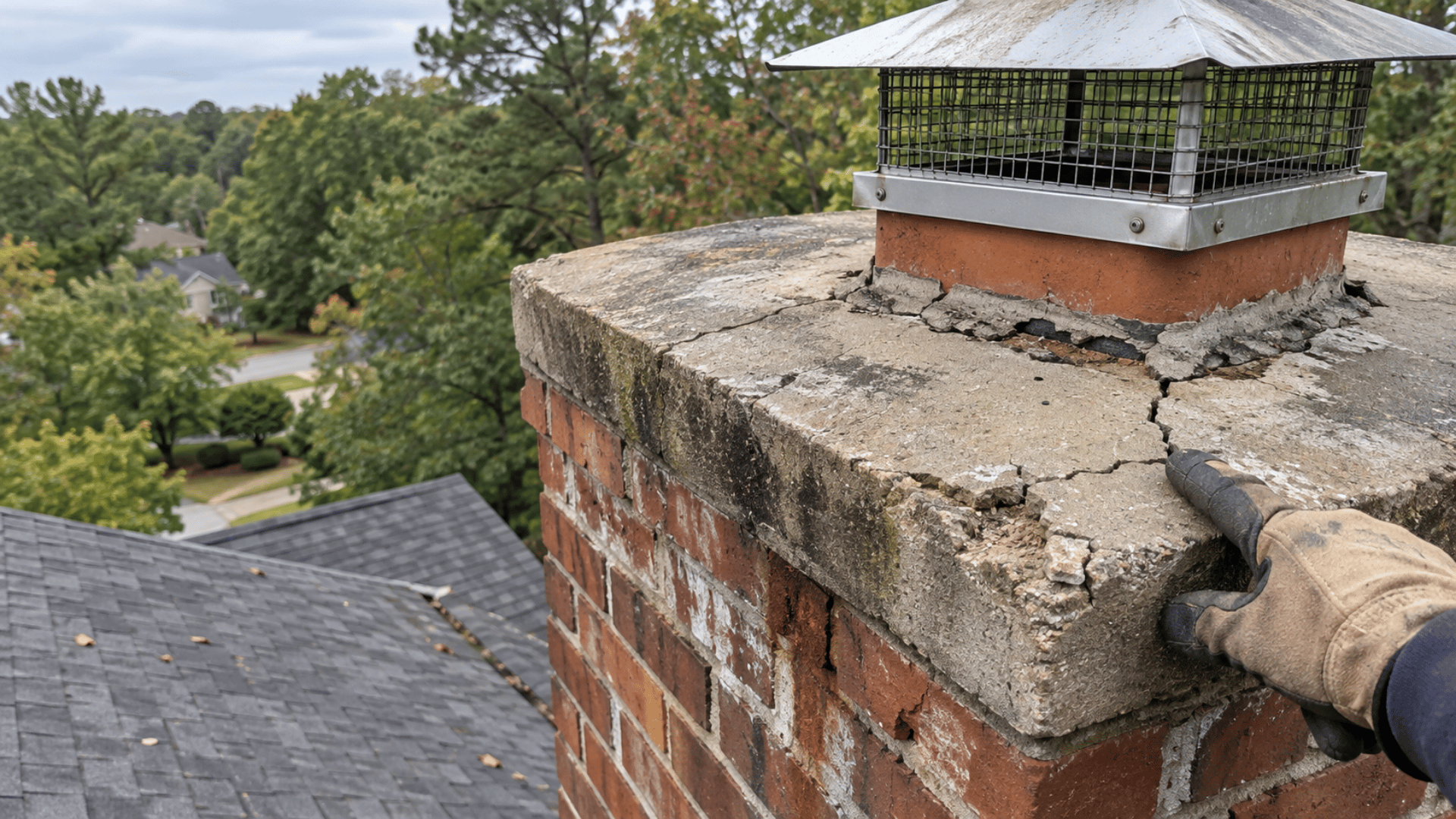
The most obvious sign is also the easiest to ignore. Small cracks may look cosmetic from the ground, but they create an opening where water can enter the crown directly. Watch for hairline fractures, spiderweb cracking, cracks running toward the crown’s edge, or separation between the crown and the flue itself.
A structurally sound crown with a few minor surface cracks may still be repairable. The concern grows when cracks are deep, spreading, wider than a hairline, or paired with loose material, standing water, or damaged brick just below. CSIA notes that deteriorated crowns are a common route for moisture to reach the area around a flue liner, where freezing water can contribute to cracking and further damage — exactly why a “tiny crack” deserves an inspection before it becomes a bigger chimney crown repair.
2. Crumbling or Flaking Crown Material
A crown should feel like solid masonry — it shouldn’t flake apart, shed chunks, turn powdery, or develop hollow spots. Once pieces start breaking away, the problem has usually moved past simple cosmetic weathering.
One common reason: some chimneys were never built with a real cast concrete crown at all. Instead, the top was finished with a thin layer of mortar — sometimes called a mortar wash. Mortar is excellent for joining bricks together; it was never designed to face decades of rain, heat, and freezing temperatures on its own. CSIA specifically describes a cast crown with a proper expansion joint as the preferable long-term replacement for a sand-and-mortar wash. If your chimney top is thin, brittle, or peeling apart, repeatedly coating it may just delay the inevitable — the crown may need to be rebuilt correctly instead.
3. Rust Stains Below the Crown
Orange or reddish streaks around the upper chimney mean moisture is reaching metal somewhere in the system — a cap fastener, reinforcement, flashing, or the damper. Rust alone doesn’t prove the crown is the only source, but it tells you something important: water is getting somewhere it shouldn’t.
CSIA warns that visible rust around the fireplace area can signal that water damage higher in the chimney has already become significant. If rust is showing up beneath a cracked crown, the whole chimney top deserves a look — the crown, cap, top brick courses, flue liner, and flashing together, not just the stain itself.
4. Spalling Bricks Under the Crown
Spalling happens when the hard outer face of a brick cracks, flakes, or pops away entirely — broken faces, red brick fragments on the roof, or exposed soft brick underneath. It almost always starts with moisture: brick and concrete are porous, and once water gets in and freezes, the expansion damages the material from within. EPA moisture-control guidance specifically notes that brick and concrete can be damaged by freeze-thaw cycling.
A few damaged bricks may be individually repairable. But widespread spalling directly beneath the crown usually means the upper chimney has been wet for years — and at that point, simply coating the crown isn’t enough. The damaged masonry underneath has to be addressed first.
5. White Powdery Stains (Efflorescence)
White, chalky deposits on chimney brick are called efflorescence — they form when water travels through masonry, dissolves mineral salts, and leaves them behind as the moisture evaporates. Efflorescence usually isn’t the main problem by itself; it’s evidence that water is moving through the structure. If you see it below a cracked crown, especially around the upper brick courses or mortar joints, cleaning off the stain doesn’t fix the source. You still need to find where the water’s actually getting in — the crown, a missing cap, failing mortar, or a flashing leak.
6. Debris Inside the Fireplace
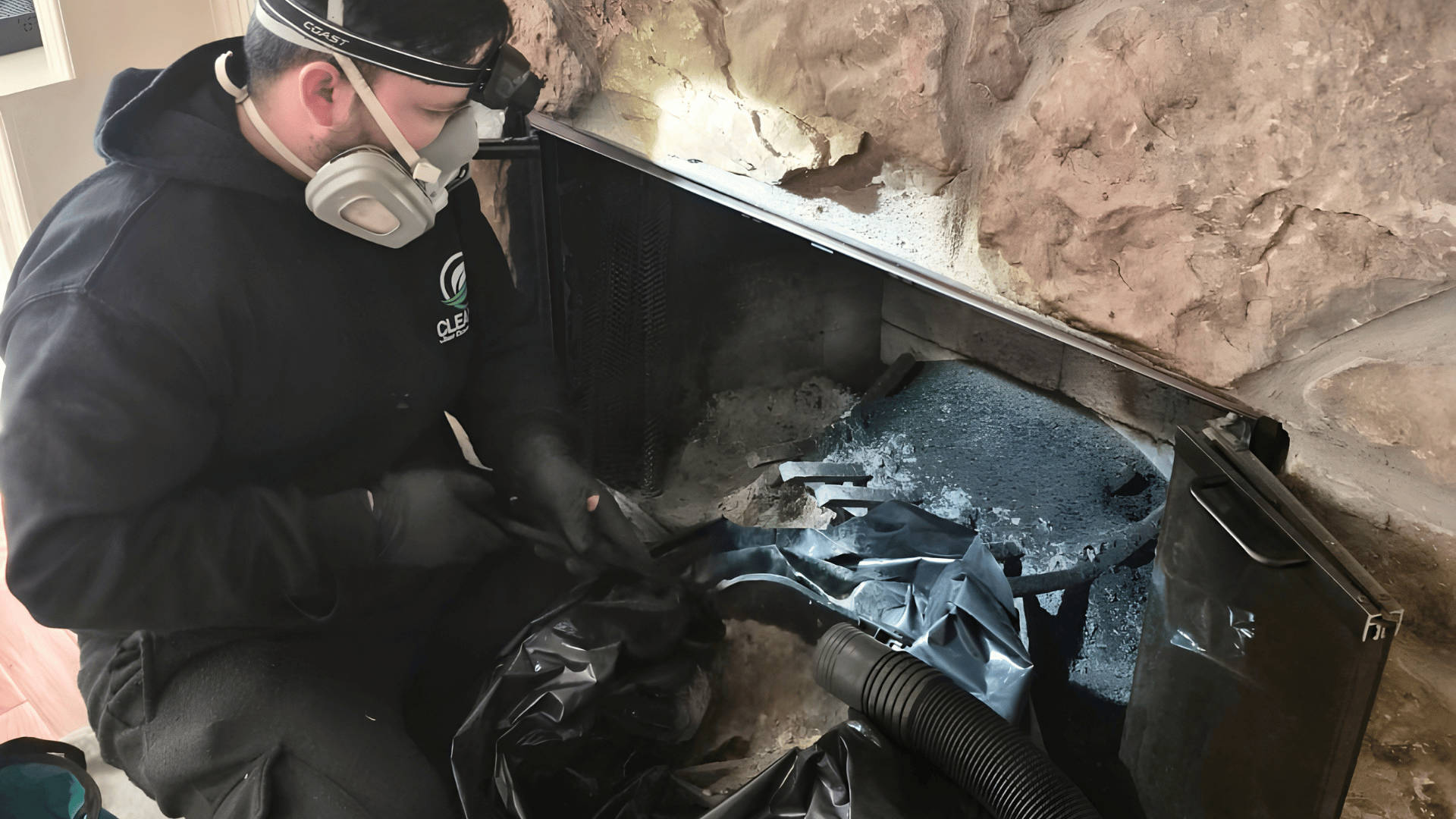
Finding chunks of mortar, concrete, or clay tile at the bottom of the fireplace is a more serious sign — don’t assume it just fell because the chimney is old. It can point to deterioration higher in the system. CSIA’s Level 2 inspection procedure specifically requires checking the crown, and notes that NFPA 211 calls for a bond break where the top flue tile passes through the crown, so the flue can expand vertically without being restrained. If a crown was poured tightly against the tile with no separation, thermal movement can put real stress on the liner over time. If you find tile or masonry pieces inside your fireplace, don’t light another fire until the system has been professionally inspected — that’s no longer just an exterior waterproofing issue.
7. Water Leaking Into the Fireplace
Water inside the fireplace is the sign most homeowners finally take seriously — but by the time it reaches the interior, the leak has usually been developing for a while. Watch for puddling in the firebox, a damp hearth, a rusted damper, stains above the mantel, ceiling stains near the chimney, or a musty odor. A cracked crown is one possible cause, but not the only one — water can also enter through a missing cap, failed flashing, deteriorated brick, or a rusted chase cover. A real inspection should identify the actual water path rather than assuming every leak comes from the same place — see our guide on why chimneys leak water inside for the full breakdown.
One thing worth remembering across all seven signs: a dry fireplace doesn’t mean a dry chimney. Water damage develops from the top down, and brick, mortar, and hidden chimney spaces can absorb plenty of moisture before you ever see a stain, a rusted damper, or water in the firebox. Catching a crown problem while it’s still localized is far cheaper than waiting for it to show up inside the house.
Why Chimney Crowns Fail in Atlanta
Freeze-Thaw Cycling
Atlanta isn’t a northern winter climate, but temperatures regularly cross the freezing point in winter — and that matters more than people expect. A wet crown absorbs moisture during rain, then sits through an overnight freeze. When that trapped water freezes, it expands, and repeated cycles gradually enlarge small cracks. NWS data confirms Atlanta routinely sees freezing conditions, with an average first freeze in mid-November and winter lows well below freezing some years. The damage doesn’t usually happen in one dramatic night — it accumulates, one freeze at a time.
Poor Original Construction
Many crown failures actually begin on the day the chimney was built. Common shortcuts include using mortar instead of real cast concrete, pouring the crown too thin, skipping the slope, skipping the overhang, and leaving out the expansion separation around the flue. None of this shows up for years — then the cracks start appearing, and a full chimney crown repair becomes necessary sooner than it should have.
Summer Heat and UV Exposure
Atlanta crowns also spend months exposed to intense summer sun. Repeated heating, cooling, moisture, and UV exposure gradually degrade coatings and widen existing cracks — which is why crown maintenance needs to account for the whole year, not just winter.
Proper Chimney Crown vs. Cheap Mortar Wash
Homeowners often don’t realize these are two very different things — and the difference decides whether a coating will actually hold.
Proper Chimney Crown
A properly built crown functions like a small roof for the chimney. It should have durable concrete construction, adequate thickness, a slope away from the flue, an overhang beyond the brick, a drip edge, and separation around the flue tile. A quality cast crown is designed to shed water, not absorb and hold it.
Mortar Wash
A mortar wash is a much simpler build — usually a thin layer of mortar shaped over the top course of brick. It tends to have thin edges, minimal structural strength, no real overhang, and no drip edge, and it cracks fast under direct weather. It might look fine when new, but repeatedly patching a deteriorated wash never turns it into a properly built crown — at some point, it needs to be rebuilt as one.
A Real Example From a Sandy Springs Home
A homeowner in Sandy Springs noticed a tiny crack near the top of the chimney, plus a small stain upstairs after a hard rain. From the yard, it didn’t look serious — they expected a quick crack-sealing job, maybe starting around $200.
But once a technician got on the roof, the situation changed. The crown wasn’t really a cast concrete crown at all — it was an old, porous mortar wash, and that visible crack had been open for three or four winters. Every time it rained, water got in, and instead of running off the top, the chimney had been acting like a sponge.
Flue Damage
The original crown had no proper expansion separation around the clay flue. Moisture had built up around the upper liner, and repeated cycles of cold weather and thermal movement had cracked the clay tile. The problem was no longer just waterproofing — the venting system itself needed evaluation.
Hidden Spalling
From the yard, the exterior brick still looked decent. Underneath the crown, it was a different story — the top courses had been repeatedly saturated, and once opened up, they were soft and no longer capable of supporting a new crown.
Rust and Interior Water Damage
Water had traveled further down than anyone expected. The damper showed significant corrosion, and nearby framing showed signs of prolonged moisture exposure.
What started as a “small crown repair” became upper masonry reconstruction, flue repair, a properly built new crown, and water-damage correction — a project running into the thousands instead of a few hundred dollars. That’s the real cost of waiting for visible interior leakage before acting.
Chimney Crown Repair vs. Rebuild: How We Decide
Not every cracked crown needs demolition. But not every cracked crown should just get another coat, either. The decision comes down to what’s underneath.
When a Repair Is Enough
- Cracks are minor and superficial
- The concrete underneath is solid, and the crown is firmly attached with no hollow areas
- Slope and overhang are both correct
- Upper brickwork is stable and flue tiles are sound
- There’s no major water damage underneath
When a Rebuild Is Needed
- The “crown” is primarily a deteriorated mortar wash
- Large sections are missing, loose, or sound hollow when tapped
- Deep cracks run through the slab, or edges are collapsing
- The crown is flat or holds water, with no meaningful overhang
- Upper bricks are deteriorating, the flue expansion detail is wrong, or previous coatings keep failing
What a Proper Chimney Crown Repair Includes
A real repair starts before any sealant gets opened. The technician should first inspect the flue tile, cap, top brick courses, mortar, and crown condition together — if the masonry below is already failing, that needs to be addressed before any crown work begins.
From there, the surface gets properly prepared: dirt, loose material, moss, and any failed previous patches removed, with the crown allowed to dry before cracks are opened and treated with compatible repair material. Only then does a chimney-specific elastomeric crown coating go on — and only when the crown itself is structurally sound. A coating is protection. It isn’t structural reconstruction, and sealing a wet, dirty, or already-failing crown just sets up an early repeat of the same problem.
What a Proper Chimney Crown Rebuild Includes
Remove the Old Crown and Check the Brick First
The failed crown or mortar wash gets carefully demolished, exposing the masonry underneath so the contractor can actually see whether it’s stable. Loose or badly deteriorated upper brick gets repaired before any new concrete is poured — you can’t build a durable crown on top of unstable masonry, no matter how well the crown itself is built.
Build In the Slope, Overhang, and Expansion Joint
Proper formwork is built so the finished crown projects beyond the brickwork — CSIA recommends roughly a two-inch projection on all sides, moving water away from the vertical masonry instead of letting it wash straight down the brick. The clay flue also needs its own bond break or expansion detail, since it heats up and cools differently than the surrounding concrete — CSIA specifically identifies this separation as part of proper chimney-top construction. And the crown itself needs a real slope away from the flue, so water moves toward the outer edge instead of pooling in a bowl around the tile.
Pour, Cure, and Protect Properly
A properly designed concrete crown gets formed and poured — not smeared brick mortar across the top — with reinforcement added where the design calls for it. Fresh masonry then needs real time and the right conditions to cure; rushing straight into a waterproof coating, or exposing uncured work to bad weather, can compromise the whole job. Once cured, a compatible waterproof product may be applied following the material and manufacturer’s specifications.
Document the Work
You shouldn’t have to climb onto your own roof to know whether the job was done right. Ask for before photos, demolition photos, photos of the masonry underneath, the expansion-joint detail, the formwork, and the finished crown. You should be able to see exactly what you paid for.
One more thing worth watching for: the same construction mistakes that cause crowns to fail in the first place — mortar instead of real concrete, no expansion joint, no overhang, a flat pour — are exactly what shows up when a “rebuild” is really just a repeat of the original problem. If a contractor can’t clearly explain the slope, the overhang, and the flue separation in their own rebuild, that’s worth asking about directly.
How Much Does Chimney Crown Repair Cost in Atlanta?
| Tier | Price Range | What’s Included |
|---|---|---|
| Minor Crack Repair & Coating | $150 – $450+ | Surface prep, minor crack treatment, elastomeric coating — only makes sense on a structurally sound crown |
| Major Repair or Partial Reconstruction | $500 – $1,200+ | Wider cracks, localized concrete reconstruction |
| Full Crown Replacement | $1,000 – $3,000+ | Complete demolition and rebuild; larger or complex chimneys can run higher |
Every chimney is different, so this should never be treated as a fixed menu. A few things commonly push the price up: a steep or multi-story roof that needs scaffolding or fall-protection equipment, a large multi-flue chimney requiring custom formwork, deteriorated brick underneath that needs rebuilding before the crown goes on, a cracked flue liner needing its own repair, a chimney cap that’s rusted or missing and worth replacing at the same time, or additional flashing and masonry work if the crown wasn’t the only source of the leak. That’s why the right first step is always an inspection — not guessing at a price from the ground.
Can You Repair a Chimney Crown Yourself?
We don’t recommend experimenting with crown repairs from the roof, for two reasons. First, chimney access is a genuine fall hazard. Second, the visible crack may not be the actual extent of the problem — you can cover a crack with silicone and still miss deteriorated brick underneath, flue tile damage, a missing expansion joint, or a hollow section, hiding the symptom while the actual cause keeps working on the chimney underneath it.
Avoid regular household silicone, latex caulk, black roofing tar, a random concrete patch, or fresh mortar smeared over failing mortar — a crown repair needs materials actually designed for the conditions it’s going to face.
What Atlanta Homeowners Can Check From the Ground
Don’t climb onto the roof yourself — use binoculars or your phone’s zoom instead. Look for visible cracks, missing pieces, separation between the crown and flue, white efflorescence, rust streaks, spalling brick, or a leaning or loose cap. Then check inside the home for water stains, musty odors, a rusted damper, a damp firebox, or clay pieces and crumbling mortar on the hearth.
Any of these is reason enough for a closer professional look. And if you find pieces of the venting system — clay tile, mortar chunks — actually falling into the firebox, or you’re seeing significant water intrusion, stop using the fireplace and have the flue inspected before lighting another fire. Crown damage alone doesn’t automatically mean the fireplace is unsafe, but debris from inside the system is a different kind of warning sign entirely.
What Chimney Crown Repair Won’t Fix
Fixing the crown solves water entry from the very top of the chimney — it doesn’t automatically solve everything below it. Chimney crown repair on its own won’t fix:
- Spalling brick that’s already happened. Once brick faces have popped or cracked from years of trapped moisture, that’s its own masonry repair, and in older homes it may point to a larger restoration project.
- A flue liner already cracked by past water or thermal stress. A new crown stops future damage — it doesn’t undo cracking that already occurred, which usually needs its own relining work.
- A rusted damper. If corrosion already set in before the crown was fixed, the damper itself may still need repair or replacement.
- A missing or damaged chimney cap. The crown and cap do different jobs — see our guide on chimney cap replacement cost for how they work together rather than as substitutes for each other.
- Existing interior water damage. Stained ceilings, soft drywall, or damp framing from water that already got in need their own repair, separate from the crown work itself.
If you’re not sure which of these apply, a Level 2 inspection is the way to find out before paying for a crown repair that doesn’t address everything that’s actually wrong.
How to Choose the Right Chimney Company
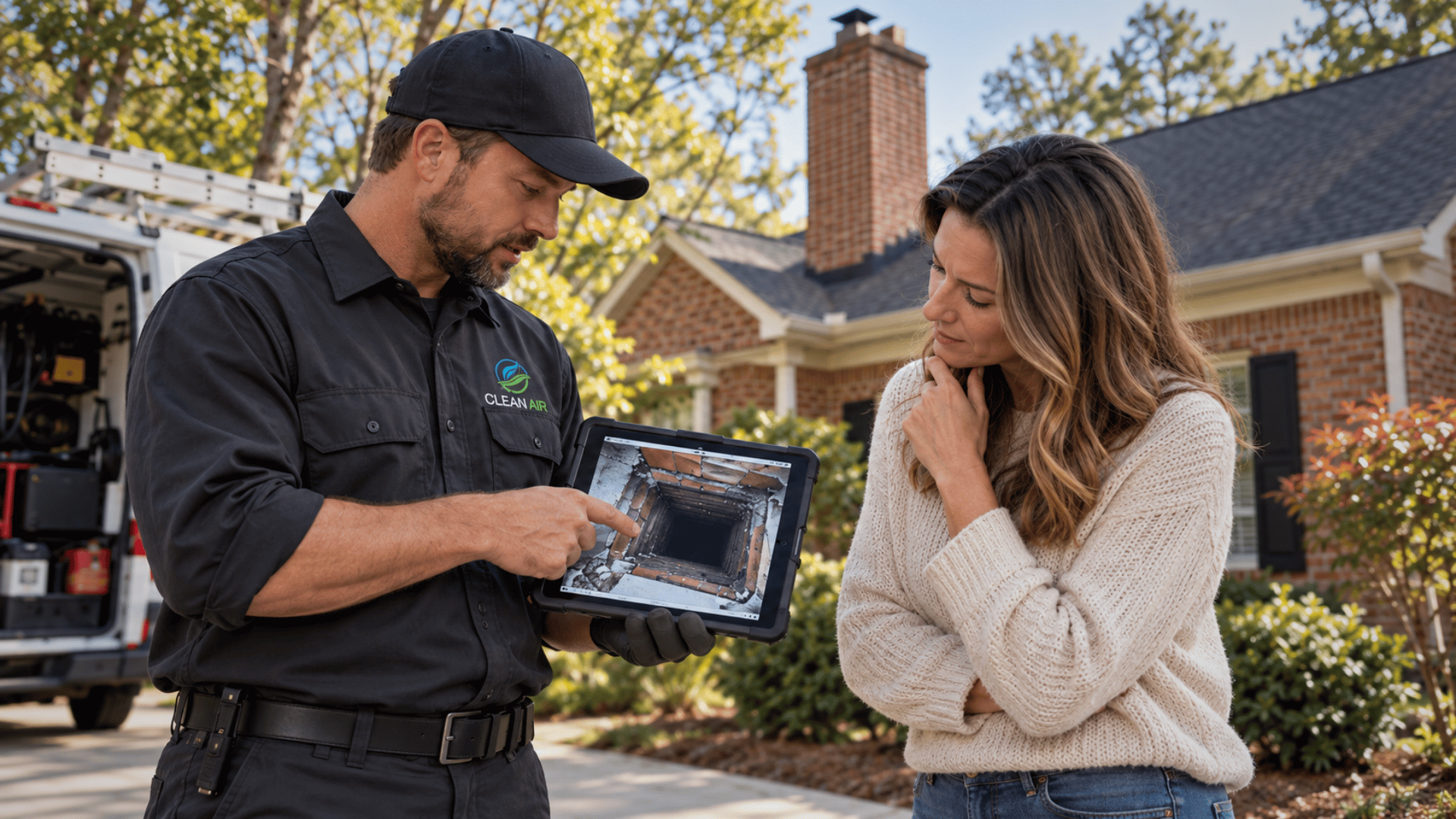
Before approving any crown work, ask directly: is this a real concrete crown or a mortar wash? Is the existing crown structurally sound, or does it need to be rebuilt — and why? Are the bricks underneath stable, and is the flue liner intact? Does the crown have proper slope, overhang, and expansion separation around the flue? A reputable contractor should be able to answer all of this clearly, and show you photos, not just tell you.
Beyond the right questions, look for the same baseline credentials that matter for any chimney work:
- CSIA certification — the Chimney Safety Institute of America sets the industry’s recognized training standard
- Proof of insurance — protects you if something goes wrong on your property
- BBB accreditation — a verifiable track record, not just a promise
- Willingness to document the work — before, during, and after photos, not just a verbal explanation
Be cautious of anyone who recommends a full rebuild but can’t show you why a repair wouldn’t be enough.
Final Answer
Think of the chimney crown as the roof of your chimney. If the roof of your house developed cracks, you wouldn’t wait until water reached the living room to fix it — treat the crown the same way. The seven signs worth remembering: visible cracks, crumbling material, rust stains, spalling brick, efflorescence, debris inside the fireplace, and water leaking in around the chimney or hearth. See one of these, investigate it. See several, act quickly — and if anyone recommends simply smearing mortar or silicone over a badly deteriorated crown, get a second opinion first.
Final Advice From Our Team
This depends on the chimney — but a $200 crack caught early rarely stays a $200 problem if it’s ignored through a few more winters. A proper chimney crown should shed water away from the masonry, accommodate movement around the flue, and protect everything underneath it. That’s what you’re actually paying for, whether it ends up being a repair or a full rebuild.
Call (470) 706-6431 or contact us to schedule a chimney crown inspection in Atlanta, GA.
FAQ
What is a chimney crown?
A chimney crown is the masonry or concrete surface at the top of a masonry chimney. Its primary purpose is to shed water away from the chimney structure.
How do I know if my chimney crown is failing?
Common signs include visible cracking, crumbling concrete, rust stains, spalling brick, efflorescence, falling masonry debris, and water intrusion.
Can a cracked chimney crown cause water inside my fireplace?
Yes. Water can enter through cracks and travel into the chimney structure. CSIA identifies damaged crowns as a common route for moisture entering masonry chimneys.
Can small crown cracks be repaired?
Minor cracks may be repairable when the underlying crown is structurally sound, properly shaped, and supported by stable masonry.
When does a chimney crown need to be rebuilt?
Rebuilding is generally more appropriate when the crown is loose, hollow, deeply cracked, badly crumbling, poorly sloped, constructed as a failing mortar wash, or sitting on damaged brickwork.
How far should a chimney crown extend past the brick?
CSIA guidance recommends that a crown project approximately two inches beyond the chimney sides to help prevent water from running directly down the brick and mortar.
Why is there a gap around the chimney flue?
The flue tile and crown experience different thermal movement. CSIA’s Level 2 chimney inspection procedure notes the need for a bond break where the upper tile passes through the crown so the flue can expand.
What is the difference between a chimney crown and a chimney cap?
The crown is the masonry or concrete surface covering the chimney top. The cap is the metal cover installed over the flue opening to help keep out rain, animals, and debris. They do different jobs, and a chimney can need both.
How much does chimney crown repair cost in Atlanta?
Minor crown work may start around $150, larger repairs around $500, and full concrete crown replacement around $1,000, with final prices increasing depending on chimney size, roof access, masonry deterioration, number of flues, and hidden damage.
Should I waterproof my chimney crown?
A compatible crown coating or water-repellent treatment can help protect sound masonry, but waterproofing should not be used to hide structural failure. The crown must first be inspected, repaired, and allowed to dry and cure appropriately.
Who should I call for chimney crown repair in Atlanta?
Call a chimney specialist who can inspect the crown, flue, upper masonry, cap, flashing, and water damage together. Clean Air Duct Cleaning & Chimney provides chimney inspections and crown repair services throughout the Atlanta metro area.