Skip to content
If you’re seeing water stains near your chimney, a musty smell in the attic, or peeling paint above the fireplace, the cause might not be your shingles at all. It’s often chimney flashing problems — issues with the waterproof metal system that seals the joint where the chimney passes through the roof.
That joint is one of the most vulnerable spots on the entire home, because two different structures meet there: the roof and the chimney. The roof moves one way. The chimney moves another way. Flashing has to protect the seam between both — which is exactly why chimney flashing problems aren’t just “roof leaks.” They’re chimney-to-roof connection failures, and if that connection was installed wrong, even a brand-new roof can still leak.
For homeowners across Atlanta, Sandy Springs, Roswell, Marietta, Alpharetta, Dunwoody, Brookhaven, Decatur, and Smyrna, this is one of the more misunderstood chimney issues we run into — the fix so often gets misdiagnosed as a roofing job when it’s really a chimney problem, or the other way around.
What Is Chimney Flashing?
Chimney flashing is the metal waterproofing installed where the chimney meets the roof. Its job is to direct rainwater around the chimney instead of letting it slip into the roof deck, attic, ceiling, drywall, or chimney chase.
A properly built system usually includes apron flashing at the lower side of the chimney, step flashing along the sides, counter flashing cut into the mortar joints, a back pan or saddle on the uphill side, an ice and water shield underneath, and a cricket behind wide chimneys when required. Building science guidance on residential roofing describes this same layered approach — step flashing integrated into the shingles, counter flashing embedded into the chimney mortar joints above it.
The flashing has to be layered correctly. It can’t rely only on caulk. Caulk is a backup. Layering is the real waterproofing — and most chimney flashing problems start the moment that layering gets skipped or done out of order.
The 4 Main Causes of Chimney Flashing Problems
Most chimney flashing problems come down to four causes: poor installation, dried-out sealant, rust and corrosion, or structural movement.
Poor Initial Installation
Poor installation is one of the biggest causes of a chimney flashing leak. Common problems include missing step flashing, counter flashing that was never cut into the mortar joint, one long strip of metal used instead of individual step flashing pieces, no ice and water shield, no cricket behind a wide chimney, or cheap sealant used as the main waterproofing method instead of a backup.
A flashing system should shed water naturally, with every layer overlapping the layer below it so water keeps moving down and away from the chimney. When flashing is installed backward, flat, loose, or out of sequence, water finds the gap — and it usually finds it fast.
Dried-Out or Cracked Sealant
Sealant doesn’t last forever. Roofers often use polyurethane caulk or roofing cement around chimney flashing, and over time, sun exposure, heat, cold, and roof movement cause it to harden, shrink, crack, and separate. Once it splits, water can get in behind the flashing.
This is especially common in Atlanta, where hot summer roof surfaces expand metal flashing, then storms and cooler weather cause it to contract again. The problem isn’t that sealant was used — it’s when sealant becomes the only thing stopping water, instead of a backup to proper metal layering.
Rust and Corrosion
Metal flashing can rust, corrode, pit, or weaken over time, especially older galvanized steel or low-grade metal. Once corrosion starts, flashing can develop pinholes, weak seams, lifted edges, and thin metal spots. Rust around chimney flashing isn’t cosmetic — it means the water-control system is breaking down. If rust stains are bleeding onto shingles, siding, or brick near the chimney base, the flashing should be inspected.
Structural Movement
A chimney and a roof don’t always move together. The house can settle, the roof framing can shift, and masonry expands and contracts differently than wood framing and asphalt shingles. That movement can pull counter flashing out of mortar joints, split sealant open, and buckle step flashing — which is exactly why a flashing system shouldn’t be rigidly glued, nailed, or fastened in a way that prevents movement. It needs to shed water while allowing the roof and chimney to move slightly without tearing the waterproofing apart.
Step Flashing vs. Counter Flashing
Homeowners often hear these terms with no idea what they actually mean. The simple version: step flashing handles water coming down the roof. Counter flashing handles water coming down the chimney wall. They work together like a two-piece raincoat system.
| Layer | Where It Sits | Its Job |
|---|---|---|
| Step Flashing | Woven into the shingle courses along the chimney sides | Pushes water running down the roof away from the chimney joint |
| Counter Flashing | Embedded into the chimney mortar joint, bent down over the step flashing | Stops water running down the brick face from getting behind the step flashing |
Step Flashing: The Under Layer
Step flashing is made of individual L-shaped metal pieces woven into the shingle courses along the sides of the chimney. One side sits under the shingle; the other turns upward against the chimney wall. The pieces are layered like stairs, so water running down the roof gets pushed away from the chimney joint instead of into it.
Counter Flashing: The Over Layer
Counter flashing installs over the top edge of the step flashing, usually embedded into a groove cut into the chimney mortar joint, then bent downward over the step flashing below. Its job is to stop water running down the brick face from getting behind the step flashing.
When one layer is missing — step flashing gone, or counter flashing gone — water finds the gap. If both are installed wrong, water can bypass the shingles completely and enter the roof deck, attic, ceiling, or walls, which is why “just caulking the edge” rarely solves a genuine chimney flashing problem.
Common Signs of Chimney Flashing Failure
Chimney flashing leaks can be tricky, because water doesn’t always show up directly under the leak — it can travel along rafters, roof decking, insulation, or drywall before becoming visible. That means the stain may appear several feet away from the actual leak.
- Brown or yellow ceiling stains near the chimney
- Water stains on walls around the fireplace
- Musty odor in the attic
- Soft drywall or peeling paint near the ceiling or mantel
- Rust streaks on shingles near the chimney base, or rust stains inside the firebox
- Warped, lifted, or cracked flashing and sealant
- Curled shingles near the chimney base
A flashing leak usually shows up around the ceiling, attic, or wall area near the chimney base. If water is dripping directly into the firebox instead, the cause is more likely the chimney cap, crown, or chase cover than the flashing itself — see why chimneys leak water inside for that full breakdown.
A Real Example From a Roswell Home
A homeowner in Roswell paid for a brand-new roof — shingles looked perfect, everything clean and fresh. Then a heavy Atlanta storm rolled through, and a water stain appeared on the living room ceiling about three feet from the fireplace.
They called the roofer back, assuming the new shingles had been installed wrong. But once the attic was inspected, the water path led straight back to the chimney framing. The shingles weren’t the problem — the flashing was. The roofing crew had reused the original 20-year-old chimney flashing instead of replacing it during the reroof. The counter flashing had pulled out of the mortar joint years earlier, and the step flashing had tiny rust pinholes from two decades of thermal expansion and weather exposure.
The new roof looked waterproof. But the chimney-to-roof connection was still old and failing underneath it. That’s the real lesson behind most chimney flashing problems: a new roof doesn’t automatically mean new chimney flashing. Always ask whether the flashing was replaced, reused, or patched during a reroof — not just assumed to be fine.
Why Chimney Flashing Problems Are Common in Atlanta
Heavy Rain and Thunderstorms
North and Central Georgia see warm, humid summers and frequent spring and summer thunderstorms, with significant annual rainfall region-wide, according to the National Weather Service. Chimney flashing has to handle large amounts of fast-moving water during these storms — and if there’s a weak seam, dried-out sealant, or a rust pinhole anywhere in the system, heavy rain will find it.
Heat and Thermal Movement
Atlanta roof surfaces get extremely hot in summer, and metal flashing expands in that heat, then contracts again during storms and cooler nights. That constant expansion and contraction cracks sealant, loosens fasteners, and opens gaps around the chimney over time — the same structural movement issue described above, just accelerated by Atlanta’s temperature swings.
Tree Debris
Atlanta’s heavy tree canopy — among the highest of any American city, per the City of Atlanta — is beautiful, but it creates real chimney flashing problems. Leaves, acorns, pine needles, and twigs collect behind the chimney base, and wet debris holds moisture against flashing and shingles, slowing drying and accelerating rust and roof deck damage. If your chimney sits under heavy tree coverage, the flashing deserves a closer look on a regular basis.
Humidity and Freeze-Thaw Cycles
Humidity keeps masonry damp longer, and damp mortar joints weaken over time. When winter temperatures drop below freezing, that trapped moisture can expand and crack mortar, brick, and sealant — loosening counter flashing that’s embedded in those joints.
Soil and Foundation Movement
In many Atlanta homes, foundation movement contributes to flashing problems too. When the house and chimney settle or shift at different rates, the roof-to-chimney joint can open up. It may not be dramatic from the ground, but even a small shift can pull flashing loose, crack sealant, and create a hidden leak path that isn’t obvious until the next storm.
Flashing Leak vs. Crown, Cap, Chase Cover, or Masonry Leak
Not every chimney-area leak is a flashing leak. The symptoms can help narrow down the actual source.
Flashing Leak
Usually affects the roofline area: ceiling stains beside the chimney, water in the attic near the chimney base, brown drywall rings near the fireplace wall, or rusted and lifted metal at the roofline. Water usually enters where the chimney meets the roof, and shows up fastest during heavy or wind-driven rain.
Chimney Crown Leak
A cracked chimney crown often sends water down inside the chimney structure instead. Signs include water in the firebox, a rusted damper, white powdery deposits on brick, and stains above the mantel — often slower to appear, since a cracked crown can make the chimney act like a sponge.
Chimney Cap Leak
A missing or damaged chimney cap lets rain fall directly into the flue — dripping inside the fireplace, loud water sounds in the flue, a wet ash smell, and a damp firebox. This is often one of the easiest problems to spot from the ground with binoculars or a phone zoom.
Chase Cover Leak
A failing chase cover — the metal pan atop a wood-framed chimney chase — often causes water to run inside the framed chimney box: rust streaks down siding, a sagging or flat metal top, and moisture inside the chase framing. Many builder-grade chase covers fail simply because they’re flat, thin, and poorly sloped.
Masonry Leak
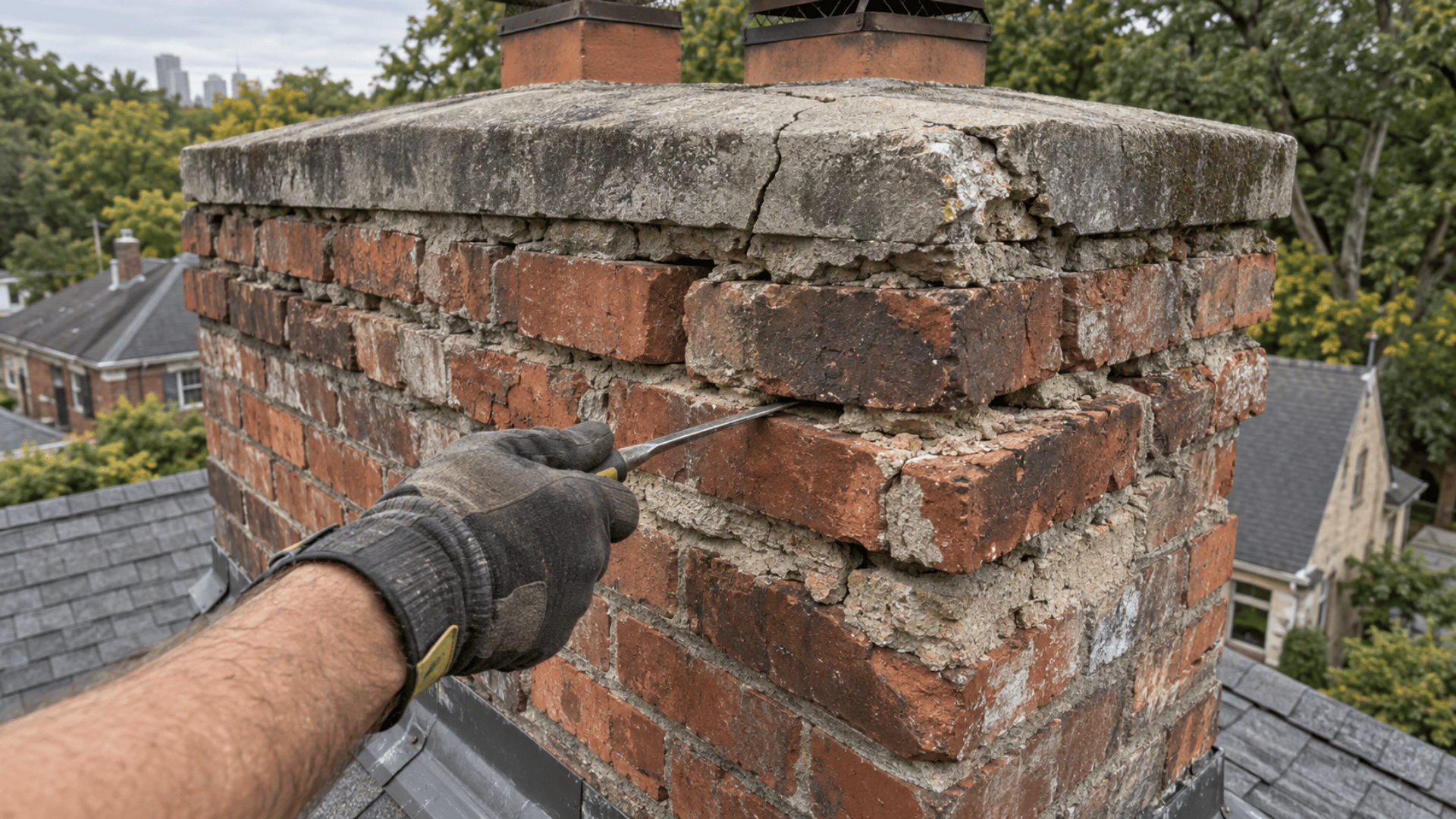
Masonry leaks happen when brick and mortar absorb water directly — widespread dampness, a musty room odor, white efflorescence, spalling brick, and crumbling mortar. These tend to be broader and less concentrated than a flashing leak, and often point toward a bigger restoration issue if caught late.
What Homeowners Should Not Do
- Don’t smear silicone or roofing tar everywhere. Hardware-store caulk and black roof cement aren’t long-term fixes for a failed flashing system — they crack, peel, and often trap moisture, making future repairs harder.
- Don’t paint over interior water stains. Painting doesn’t fix the leak. If water keeps entering behind the drywall, hidden damage can keep spreading into decking, insulation, and framing.
- Don’t assume new shingles fixed the chimney. As the Roswell example above shows, a new roof doesn’t guarantee new flashing — ask directly whether it was replaced or reused.
- Don’t approve a full roof replacement without proof. Sometimes the roof is fine and the chimney flashing is the only failed area. Ask for photos, attic evidence, and a clear explanation of the water path before agreeing to anything bigger than the actual problem.
- Don’t wait for the next big storm. A small ceiling stain means water has already entered the home. Localized chimney flashing repairs may start around $500–$1,500, depending on roof access, materials, and decking condition — waiting can turn that into rotted decking, drywall repair, and moisture-related mold risk instead.
What a Proper Chimney Flashing Repair Should Include
A real repair solves the leak at the system level — not with a quick smear of caulk.
A Full Teardown, Not Reused Flashing
Old flashing should be removed when it’s rusted, warped, loose, or improperly installed. Reusing old flashing during a reroof — as in the Roswell example — is one of the most common shortcuts in the industry, and it’s exactly how a brand-new roof ends up with an old leak still underneath it.
A Roof Decking Inspection First
Once the old flashing and nearby shingles are removed, the deck underneath should be checked for soft wood, rot, or hidden water trails. New flashing should never go over rotten decking — that’s not a repair, it’s a cover-up.
Ice and Water Shield as a Backup Layer
A self-adhering waterproof membrane should be applied to the roof deck and wrapped properly at the chimney transition before new metal goes on. Skipping this leaves the deck more vulnerable if wind-driven rain gets under the flashing later.
Apron Flashing and Individual Step Flashing Pieces
Apron flashing on the lower downslope side catches water running around the chimney and directs it onto the shingles below. Step flashing should always be individual pieces woven into each shingle course — one long continuous strip does not behave like proper step flashing and won’t shed water the same way.
Counter Flashing Cut Into the Mortar, Anchored to Move Independently
Counter flashing should be mechanically embedded into a groove cut into the mortar joint, not just surface-mounted with a bead of caulk along the top edge — the “smear and clear” method that looks fine for a few months until the sun cooks the caulk and water slips behind it. It also shouldn’t be screwed or nailed in a way that locks it to the roof deck; the chimney and roof need to move independently without tearing the seal.
A Back Pan or Cricket on Wide Chimneys
The 2024 International Residential Code requires a cricket or saddle on the ridge side of any chimney or roof penetration more than 30 inches wide, measured perpendicular to the slope. A cricket works like a small peaked roof behind the chimney, splitting water around it instead of letting it dam up and pool.
Professional-Grade Sealant, Used as a Backup
Sealant is still needed at the reglet joint where counter flashing enters the mortar — but it should be a high-quality flexible sealant or appropriate masonry material, not cheap silicone or roof tar standing in as the only waterproofing.
Checking the Rest of the Chimney, Not Just the Flashing
A good flashing repair also checks the crown, cap, chase cover, brick, mortar, and interior firebox for rust or water entry. Fixing flashing while ignoring a cracked crown or missing cap can leave you with another leak within a season — which is exactly why a full chimney inspection alongside flashing work is worth the extra time.
When to Call a Roofer vs. a Chimney Company
A roofer can help when the issue is clearly roofing-related — damaged shingles, roof decking, or a standard flashing replacement. But a chimney company should be involved when there are signs the chimney system itself may be part of the leak.
Call a chimney and fireplace company when you notice water inside the fireplace, a rusted damper, a cracked crown, spalling brick, crumbling mortar, white efflorescence, or damage inside the firebox. A flashing leak can rot the roof deck. A chimney leak can damage the firebox, liner, damper, and masonry. The safest approach is inspecting both the roof connection and the chimney system together, so you know which one you actually have.
What Chimney Flashing Repair Won’t Fix
Fixing the flashing solves the roof-to-chimney connection — it doesn’t automatically solve everything else around it:
- A cracked chimney crown. A separate leak source entirely; see our guide on chimney repair vs replacement for how to tell if a crack needs a simple repair or something bigger.
- A missing or damaged chimney cap. Flashing repair doesn’t stop rain falling directly into an open flue — that needs its own cap replacement.
- Deteriorated brick and mortar. If masonry is already absorbing water on its own, that’s a restoration project, not a flashing fix.
- A flue liner already damaged by past water entry. If moisture reached the liner before the flashing was repaired, that damage doesn’t undo itself once the leak stops.
- Existing interior damage. Soft drywall, rotted framing, or stained ceilings from water that already got in need their own remediation — sealing the source stops new damage, it doesn’t reverse what’s already happened.
If you’re already thinking ahead to winter chimney prep, flashing is worth checking as part of that same visit rather than waiting for a leak to force the issue.
How to Choose the Right Chimney Company
Before hiring anyone, ask whether they’ll remove old flashing or reuse it, whether they’ll inspect the decking underneath, and whether they’ll check the crown, cap, and masonry while they’re up there — not just the metal. A contractor who can’t answer these clearly may not be the right one for the job.
Beyond the right questions, look for the same baseline credentials that matter for any chimney work:
- CSIA certification — the Chimney Safety Institute of America sets the industry’s recognized training standard
- Proof of insurance — protects you if something goes wrong on your property
- BBB accreditation — a verifiable track record, not just a promise
A good chimney company shouldn’t just say “you need flashing.” They should show you where water is entering, which layer failed, and why the repair will last longer than a surface patch.
Final Answer
Most chimney flashing problems trace back to one of four causes: poor installation, dried-out sealant, rust and corrosion, or structural movement between the roof and chimney. A flashing leak usually shows up as a ceiling or attic stain near the chimney, while water inside the firebox more often points to the cap, crown, or masonry instead. Either way, a new roof doesn’t guarantee new flashing — the only way to know for sure is to ask directly, and to have both the roofline and the chimney system checked together.
Final Advice From Our Team
This depends on the chimney — but do not smear caulk on it and hope for the best, and do not wait for the next storm to confirm the leak is real. A small ceiling stain means water has already found a way in, and the longer it sits, the more it can spread into decking, insulation, and framing you can’t see.
Call (470) 706-6431 or contact us to schedule a chimney flashing inspection in Atlanta, GA.
FAQ
What causes chimney flashing problems?
The most common causes are poor installation, missing step or counter flashing, cracked sealant, rust and corrosion, structural movement, reused old flashing, tree debris, and storm damage.
What is chimney flashing?
Chimney flashing is the metal waterproofing system that seals the joint where the chimney meets the roof. It directs water around the chimney so it doesn’t enter the roof deck, attic, ceiling, or walls.
What is the difference between step flashing and counter flashing?
Step flashing is woven into the roof shingles along the chimney sides. Counter flashing is embedded into the chimney mortar joints and overlaps the step flashing to stop water from running behind it.
How do I know if my chimney flashing is leaking?
Common signs include brown ceiling stains near the chimney, musty attic odors, soft drywall, rust streaks near the chimney base, lifted metal flashing, cracked sealant, and moisture around the roofline.
Can chimney flashing leak even after a new roof?
Yes. A new roof can still leak if the roofer reused old chimney flashing, skipped counter flashing, installed flashing incorrectly, or failed to inspect the chimney-to-roof connection.
Can I fix chimney flashing with caulk?
Caulk alone is usually not a proper long-term fix. A real flashing repair requires correct metal layering, step flashing, counter flashing, waterproof membrane, and proper sealant used as a backup, not the main defense.
How much does chimney flashing repair cost?
Localized chimney flashing repairs often start around $500 to $1,500, depending on roof access, materials, and decking condition. Costs rise if the roof deck is rotted or the chimney needs masonry work alongside the flashing.
When does a chimney need a cricket?
A cricket or saddle is required by the 2024 International Residential Code on the ridge side of chimneys or roof penetrations more than 30 inches wide, measured perpendicular to the roof slope.
Why does water show up several feet away from the chimney?
Water can travel along rafters, roof decking, insulation, or drywall before it becomes visible. That means the stain may appear away from the actual leak source.
Should I call a roofer or a chimney company for flashing problems?
Call a roofer for roof and shingle issues. Call a chimney company when water is inside the fireplace, the damper is rusted, the crown or cap is damaged, masonry is deteriorating, or you need the whole chimney system inspected alongside the flashing.
Who should I call for chimney flashing problems in Atlanta?
Call a chimney and fireplace company that can inspect the flashing, roofline, crown, cap, chase cover, masonry, firebox, damper, attic areas when accessible, and signs of water entry. Clean Air Duct Cleaning & Chimney can help determine whether the issue is flashing, crown, cap, masonry, or chase cover related.