 Skip to content


A small chimney repair in Atlanta may start around $150 to $500. Major masonry work, stainless steel relining or a full rebuild can run several thousand dollars.
Here’s what many homeowners don’t realize: two chimneys with the same symptom can need completely different repairs and carry completely different prices. A small water stain might be a minor flashing problem, or the first visible sign of years of hidden water damage. A few mortar cracks might need simple tuckpointing, or the bricks underneath may already be loose. That’s why nobody can quote a chimney accurately from a symptom alone.
This guide covers realistic 2026 price ranges for Atlanta homes, what moves the price, when repair beats replacement, how to read an estimate, and how to prioritize on a limited budget.
Atlanta Chimney Repair Costs at a Glance (2026)
| Repair | Smaller Job | Larger Job |
|---|---|---|
| Chimney inspection, Level 1 | $160 to $300 | n/a |
| Camera inspection, Level 2 | $260 to $460 | n/a |
| Cap | $300 to $500 installed | Custom: quoted |
| Crown | $150 to $500 | $600 to $1,500+ |
| Flashing | $200 to $400 | $500 to $1,500+ |
| Waterproofing | $150 to $400 | $500 to $900+ |
| Repointing (tuckpointing) | $200 to $500 | $1,000 to $2,500+ |
| Chase cover | $300 to $600 | $700 to $1,400+ |
| Damper | $100 to $225 | $500 to $1,000+ (top-sealing) |
| Liner repair or relining | $500 to $1,500 | $2,500 to $5,500+ |
| Rebuild | $1,200 to $3,500+ (partial) | $5,000 to $15,000+ (full) |
Repair costs depend on the damage, the chimney and the work required. These are general estimates rather than fixed quotes. Structural damage, difficult access, special materials or several repairs at once can raise the total.
Inspection and Cleaning Costs
Most repairs start with an inspection to find the real problem.
| Service | Typical Starting Range |
|---|---|
| Chimney sweep | $199 to $399 |
| Level 1 inspection | $160 to $300 |
| Level 2 inspection with camera scan | $260 to $460 |
| Level 3 invasive investigation | $500 to $800+ |
| Heavy creosote or glaze removal add-on | $100 to $300+ |
| Animal nest removal | $100 to $400 |
| Deep smoke chamber cleaning | $75 to $200 |
A Level 3 inspection costs more when part of the chimney or wall has to be opened. See chimney inspection levels explained for when each is used. Some companies bundle sweeping and inspection; others price them separately, so ask what’s included.
Cost by Repair
Chimney Crown Repair: $150 to $1,500+
The crown is the concrete slab on top of a masonry chimney. It sheds rain away from the brick. When it cracks, water gets into the masonry and starts breaking down mortar and brick.
Minor crown repair, from about $150 to $500. Usually an elastomeric crown coating over limited cracks. It only makes sense when the cracks are shallow, the concrete isn’t crumbling, the crown drains, and the brick below is stable.
Full crown replacement, from about $600 to $1,500+. The better call when chunks are missing, cracks are widespread, the surface crumbles, water pools, or the crown has no proper overhang. If the concrete itself is failing, stop paying to seal cracks that will reopen. See chimney crown repair in Atlanta.
Tuckpointing: $200 to $2,500+
Tuckpointing (repointing) grinds out worn mortar and packs in new. Price scales with chimney size and how many joints need work.
Minor tuckpointing, from about $200 to $500 for small, reachable areas where the brick is still solid. Extensive tuckpointing, from about $1,000 to $2,500+ when several sides need new joints, a mortar match and access equipment.
If the bricks themselves are crumbling or loose, new mortar alone won’t hold, and the chimney may need a partial rebuild. Older homes need extra care: the National Park Service warns that mortar harder than old, soft brick can damage it, so on historic chimneys the right mix matters more than the strongest one. See chimney tuckpointing in Atlanta.
Flashing Repair: $200 to $1,500+
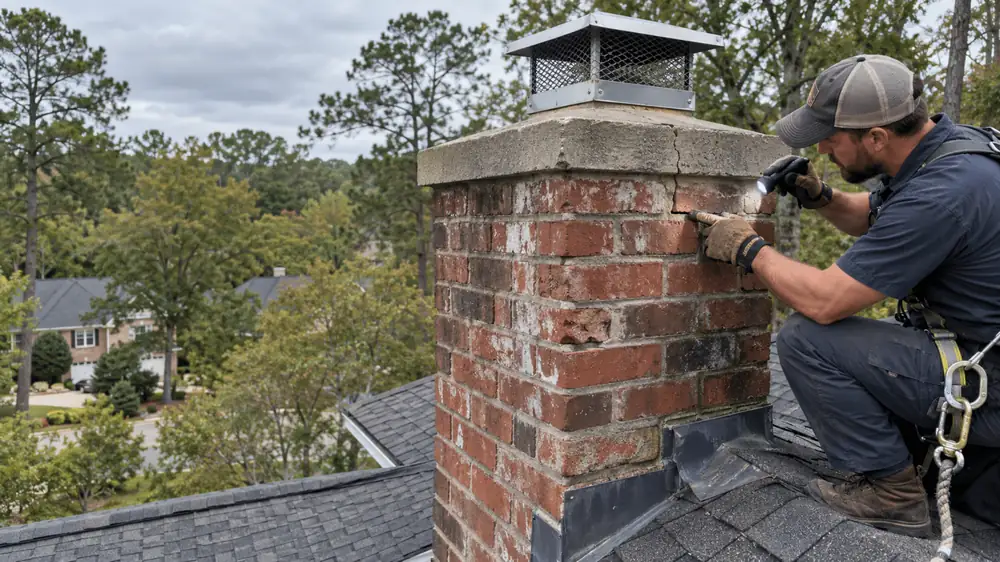
Flashing is the step and counter flashing that seals the chimney to the roof. When it fails, rain runs in between them. It’s also an easy place to overspend, because the money is wasted if the leak is really coming from somewhere else.
Minor flashing repair, from about $200 to $400 for one failed joint on otherwise good metal (sealant over damaged metal rarely lasts). Full replacement, from about $500 to $1,500+, including removing the old flashing, checking the roofing around it and installing new step and counter flashing.
A ceiling stain beside the fireplace doesn’t prove the flashing is the problem. Find where the water actually gets in first. See chimney flashing problems and why your chimney leaks water inside.
Waterproofing: $150 to $900+
Atlanta averages about 49.7 inches of rain a year, according to the National Weather Service, and porous brick soaks it up.
Standard waterproofing, from about $150 to $400 for a smaller, sound, accessible chimney. Larger jobs, from about $500 to $900+ with more brick, heavy cleaning or hard access.
We use vapor-permeable silane or siloxane repellents that keep rain out but let moisture escape. Paint and film-forming coatings trap water. Waterproofing isn’t a structural repair. It can’t fix missing mortar, loose brick, a cracked crown or failed flashing. See does your chimney need waterproofing?
Chase Cover Replacement: $300 to $1,400+
Prefab chimneys have a metal chase cover over the wood-framed box.
Galvanized cover, from about $300 to $600. Cheaper, but it rusts, especially where water pools. Custom stainless cover, from about $700 to $1,400+, with proper slope, a raised flue collar, a skirt with drip edge and a good storm collar.
A failed storm-collar seal can sometimes be repaired if the metal is sound. Pinholes, deep rust or a sagging pan that holds water mean replace it. See chimney chase cover problems.
Relining: $500 to $5,500+
The liner carries smoke and gases out and keeps heat contained. Damage can mean cracked or missing clay tiles, failed joints, corroded metal or a flue that’s the wrong size for the appliance.
| Liner Job | Typical Cost |
|---|---|
| Sealing joints in a clay liner (resurfacing) | $500 to $1,500 |
| Stainless steel liner, fireplace or insert | $2,500 to $5,500+ |
| Cast-in-place liner | Quoted after a camera inspection |
Not every crack can be patched safely. A stainless job can include the camera inspection, flue cleaning, removing broken tile, a sized and listed liner, insulation, connections and a top cap. CSIA recommends a camera inspection after a chimney fire because liner damage often isn’t visible from below. Before approving thousands for relining, ask to see the footage. See chimney liner damage.
Rebuild: $1,200 to $15,000+
Partial rebuild, from about $1,200 to $3,500+ when upper bricks are loose, mortar has failed deep, or damage sits above the roofline. Full rebuild, from about $5,000 to $15,000+ when structural failure runs well below the roofline and may include demolition, new brick, a crown, flashing, flue work and framing or foundation repair.
If the structure is stable and only the joints are worn, tuckpointing saves most of the chimney. The question isn’t whether it looks old. It’s whether the structure is still sound. See chimney repair vs. replacement.
Two smaller repairs have their own guides: chimney cap replacement cost ($300 to $500 for most stainless caps) and chimney damper repair ($100 to $225 for a simple fix, $350 to $700 for a throat damper, $500 to $1,000+ for a top-sealing damper).
One Atlanta Repair, Line by Line
The following is a hypothetical example to show how costs can add up. It is not a customer invoice or a quote.
Imagine noticing a ceiling stain near your fireplace after spring storms, along with clay-colored fragments in the firebox. You might expect a small flashing or crown repair and budget about $250.
In this hypothetical example, an inspection identifies a badly cracked crown letting water into the upper brick. The mortar there has failed and several courses are loose. The chips in the firebox call for a Level 2 camera scan, which shows cracked clay flue tiles and failed joints.
| Work Needed | Illustrative Cost |
|---|---|
| Partial upper rebuild | $2,800 |
| New concrete crown | $850 |
| Stainless steel relining | $3,750 |
| Total | $7,400 |
The higher amount would not represent the same repair. The job was completely different: loose masonry and a damaged flue, not a crown patch. That’s why the inspection comes first.
What Drives the Price
Access and property:
- Roof height and pitchA single-story ranch is easy. A steep three-story roof may need staging or a lift, which can add roughly $500 to $2,500+ on complex jobs.
- Historic brick and mortarMatching old brick, mortar color and joint profile takes time. See chimney restoration for older Atlanta homes. Historic districts may also need approvals.
- TreesOverhanging limbs can slow the work or need a tree service first.
- Several fluesMore flues can mean bigger caps or more liner work, but one bad flue doesn’t automatically mean replacing all of them.
Hidden damage:
- Water damage in roof decking, attic framing, drywall or insulation can grow the job well past the chimney.
- Deeper masonry failure can sit behind brick that looks fine. The estimate should explain how surprises get documented and priced before extra work starts.
Fees you may see:
- Service call or inspection: about $100 to $400
- Scaffolding or special access: about $200 to $800 for simpler setups, more for complex ones
- Brick and debris disposal: about $50 to $200
- Permits where required: about $75 to $200
- Carpentry, roofing, drywall or specialty historic materials
None of these are automatic. They should be explained in writing, and some may already be in the quoted price.
Repair or Replace? Which Is the Better Investment?
The cheapest repair isn’t always the most economical, but replacing a whole component when a sound local repair would do is just as wasteful.
| Part | A Local Repair May Work | Replacement or Rebuild May Be Better |
|---|---|---|
| Crown | Minor cracks, solid concrete | Crumbling, missing pieces |
| Mortar | Sound brick, worn joints in places | Loose or badly damaged brick |
| Flashing | One repairable gap, good metal | Widespread rust or bad installation |
| Chase cover | Good metal, one failed seal | Sagging, rusted through |
| Liner | Limited damage suited to an approved repair | Widespread cracking or collapse |
| Structure | Stable, with local defects | Movement or deep deterioration |
If the job calls for a rebuild, or you’d rather take an unused chimney down, see chimney demolition.
Selling soon? “I’m moving in two years, so I’ll do the cheap fix” doesn’t make unsafe work acceptable. Pick the least expensive repair that actually fixes the problem.
What a Cheap Repair Won’t Fix
- A failing crown. Sealant on crumbling concrete means paying again when the cracks reopen.
- Mortar over loose brick. New joints won’t hold unstable brick.
- Damage under waterproofing. Sealer can’t replace missing mortar or fix flashing.
- The wrong leak source. New flashing doesn’t help if water comes through the crown.
- A liner that isn’t safe to patch.
- Damage already inside. Repainting a stained ceiling doesn’t stop the leak.
How to Read a Chimney Repair Quote
A fair quote tells you exactly what you’re paying for. Check that it lists:
- The problem and where it is, with photos from the roof or camera
- The repair, item by item, not “chimney repair, $2,800”
- Materials: stainless or galvanized, the crown mix, the type of sealer
- What’s not included: roof patching, painting, permits
- Warranty on labor and materials, how long, and whether it transfers
- Whether it fixes the cause. A brick repair without fixing the cap or crown that let water in will fail again.
A useful explanation sounds like: “The crown is cracked, water is reaching the upper brick, and several courses have loose joints, so tuckpointing alone won’t hold.” Not: “Your chimney is bad and needs rebuilding.” If a cheaper safe option exists, the contractor should mention it. If hidden damage is suspected, the quote should say how change orders work.
Red flags:
- No photos or explanation of the diagnosis
- Pressure to sign today, or a discount only if you approve on the spot
- Expensive work with no reason given for why a smaller fix won’t do
- Claims that your insurance will be voided unless you approve now
For a multi-thousand-dollar liner or rebuild, a second qualified opinion that looks at the actual condition, not just price, is worth it.
Quoted $6,000 but Only Have $2,000?
Don’t automatically reject the quote or approve all of it. Sort it into three groups.
- Safety and structural hazards (now)Loose or falling brick, a badly damaged liner, signs of a chimney fire, heavy smoke backup or structural movement. If the flue is unsafe, don’t use the fireplace or appliance until it’s fixed. If the chimney itself is unstable, not lighting a fire doesn’t remove the falling-brick risk.
- Active leaks (soon)A leaking crown or flashing should be handled promptly. Temporary measures should be called temporary.
- Preventive work (later)Minor, stable mortar wear, preventive waterproofing and cosmetic work can often wait, based on a professional’s assessment.
A practical first phase might stabilize an unsafe section and add temporary water protection, with the fireplace out of service until the liner is fixed. Phasing spreads out the cost but only works if it doesn’t leave a hazard. Ask your contractor: “My budget is $2,000 right now. What must be done now, what can safely wait, and what should I avoid in the meantime?”
Does Homeowners Insurance Cover Chimney Repair?
Sometimes. It depends on the cause and your policy. The National Association of Insurance Commissioners explains that homeowners insurance generally covers sudden events like fire, wind or hail, not wear and maintenance.
May be covered: a tree limb hitting the chimney in a storm, lightning, some chimney-fire damage, wind damage and other sudden events.
Usually treated as maintenance: slowly worn mortar, long-term leaks, rusted chase covers, an aging crown and general wear.
What to document: photos, the date of the event, storm details, inspection findings, a written estimate and any interior damage. Photos support a claim but don’t prove when damage happened. The adjuster decides based on your policy, so ask your insurer what they need.
7 Ways to Lower Your Repair Bill
- Schedule non-urgent work before winterSpring and summer usually have more open dates.
- Catch problems earlyA small crown crack costs far less before water spreads.
- Bundle repairsTuckpointing and crown work in one visit can share access and setup costs.
- Get a second opinion on big jobsMake sure it evaluates the chimney, not just the price.
- Prep the houseClear the fireplace area and leave room for equipment. Leave roof and tree work to pros.
- Compare materials, not just totalsGalvanized vs. stainless, coating vs. new crown, generic vs. historic mortar.
- Fix the causeRepeated tuckpointing is wasted money if rain keeps coming through failed flashing.
Before You Spend a Dollar
If you’re holding a $3,000, 5,000 or 7,000 estimate, the first question isn’t “Can someone do it cheaper?” It’s: “Can you show me exactly what’s damaged, explain why it needs repairing, and tell me if there’s another safe option?”
A small repair can prevent bigger bills when the structure is sound. When the brick is loose or the flue is damaged, a cheap patch just postpones the real fix.
Frequently Asked Questions
Minor repairs start around $150 to $500. Extensive tuckpointing, flashing replacement, a new crown, relining or a rebuild can cost thousands, depending on condition and scope. These are typical Atlanta price ranges, not Clean Air quotes.
Roof access, safety equipment, masonry demolition, custom metalwork and flue repairs all add up, and hidden damage can grow the job once work starts.
A partial rebuild starts around $1,200 to $3,500+. A major structural rebuild starts around $5,000 and can exceed $15,000. These are typical Atlanta price ranges, not Clean Air quotes.
A full rebuild, followed by stainless steel relining. For any one chimney, though, the most expensive repair is often the one done twice because the first fix treated a symptom.
Minor repairs start around $150 to $500. A full new crown starts around $600 to $1,500+. These are typical Atlanta price ranges, not Clean Air quotes.
Small areas start around $200 to $500. Full tuckpointing often starts around $1,000 and can pass $2,500. These are typical Atlanta price ranges, not Clean Air quotes.
Resurfacing a clay liner starts around $500 to $1,500 when it’s suitable. A full stainless liner starts around $2,500 to $5,500+. These are typical Atlanta price ranges, not Clean Air quotes.
No. It’s for system changes, home sales, events like a chimney fire, or questions a Level 1 can’t answer. A major liner recommendation should be backed by camera evidence.
Sometimes, as long as phasing doesn’t leave a structural or safety hazard. The fireplace may need to stay out of use until venting repairs are done.
It may cover sudden events like fire or storm damage. Wear and maintenance are usually excluded. Coverage depends on your policy.
For a multi-thousand-dollar liner or rebuild, yes, as long as it evaluates the actual condition.
If it has known damage, get it assessed. A documented repair can ease buyer concerns. A cosmetic patch isn’t a substitute for fixing an unsafe condition.
Not always. It may reflect a smaller real scope. It’s a problem when important work, materials or safety steps were left out.
Ask for photos of the damage, a detailed scope, the materials and the warranty. For major work, consider a second opinion.
For small cosmetic jobs, maybe. Crowns, flashing, liners and fireboxes have fire and water details that need a chimney professional. A wrong repair often costs more to undo.
A well-built brick chimney can last 50 to 100 years with upkeep. Crowns, caps, flashing and sealers wear out sooner and need attention every 10 to 25 years.


